
Wegovy vs Zepbound compares two weekly weight-loss shots made by rival companies. Wegovy contains semaglutide from Novo Nordisk, and Zepbound contains tirzepatide from Eli Lilly. In SURMOUNT-5, the only head-to-head trial, average weight loss after 72 weeks was 20.2% on Zepbound and 13.7% on Wegovy at the 2.4 mg dose. On October 2026 cash prices, Zepbound costs $299 to $449 for each 28-day fill and Wegovy pens $199 to $399.
A larger average loss is only one part of the decision. Approved uses, side effects, other medicines, insurance coverage and price all differ, and the higher Wegovy HD dose was not part of SURMOUNT-5. The final choice is made with a prescriber, and the sections below lay out what to weigh.
In this guide
Wegovy vs Zepbound at a glance
Both drugs are once-weekly injections with a shared boxed warning and mostly digestive side effects. They differ in the molecule, the dose ladder, the approved uses and the way insurers treat them.
SURMOUNT-5: 751 adults without diabetes, open-label, Lilly-sponsored, Wegovy up to 2.4 mg. Labels and cash prices as of October 2026.
Wegovy was approved for weight management in 2021, and Zepbound in November 2023. Wegovy has a longer record and broader indications, while Zepbound produced more weight loss in the direct comparison.
Two molecules: semaglutide and tirzepatide
Both drugs mimic gut hormones that signal fullness and slow stomach emptying. The difference lies in how many hormone receptors each one activates.
- Semaglutide activates the GLP-1 receptor only. It is sold as Wegovy for weight and as Ozempic and Rybelsus for type 2 diabetes.
- Tirzepatide works on the GLP-1 receptor plus a second gut-hormone receptor called GIP. It is sold as Zepbound for weight and as Mounjaro for type 2 diabetes.
- Both are peptides that stomach enzymes would break down, so both are injected under the skin. Only semaglutide has an approved pill version.
- Both stay in the body for days. Semaglutide has a half-life of about a week, and tirzepatide about 5 to 6 days, which allows one dose a week.
No generic version of either drug is sold in the US as of October 2026. Semaglutide patents began expiring in some other countries, such as Canada, India and China, during 2026, and generics there do not change US access or prices. Products sold online as “generic Wegovy” or “generic Zepbound” in the US are compounded or counterfeit.
The dual action of tirzepatide is the usual explanation for its larger average loss, though the exact mechanism is still studied. Searches for Zepbound vs Wegovy often turn up the diabetes brands too, since they share the same ingredients and differ only in approved use and dose.
SURMOUNT-5: the head-to-head result
SURMOUNT-5 is the only published trial that compared the two drugs directly. It enrolled 751 adults with obesity and no diabetes in the US and Puerto Rico, and each person took the highest dose they tolerated for 72 weeks. Results were presented in May 2025 and published in the New England Journal of Medicine.
| Measure | Zepbound, 10 or 15 mg | Wegovy, 1.7 or 2.4 mg |
|---|---|---|
| Average weight loss | 20.2% (about 50 lb) | 13.7% (about 33 lb) |
| Lost at least 10% | 81.6% | 60.5% |
| Lost at least 15% | 64.6% | 40.1% |
| Lost at least 20% | 48.4% | 27.3% |
| Lost at least 25% | 31.6% | 16.1% |
| Waist reduction | 18.4 cm (7.2 in) | 13.0 cm (5.1 in) |
| Stopped due to side effects | 6.1% | 8.0% |
| Stopped due to digestive side effects | 2.7% | 5.6% |
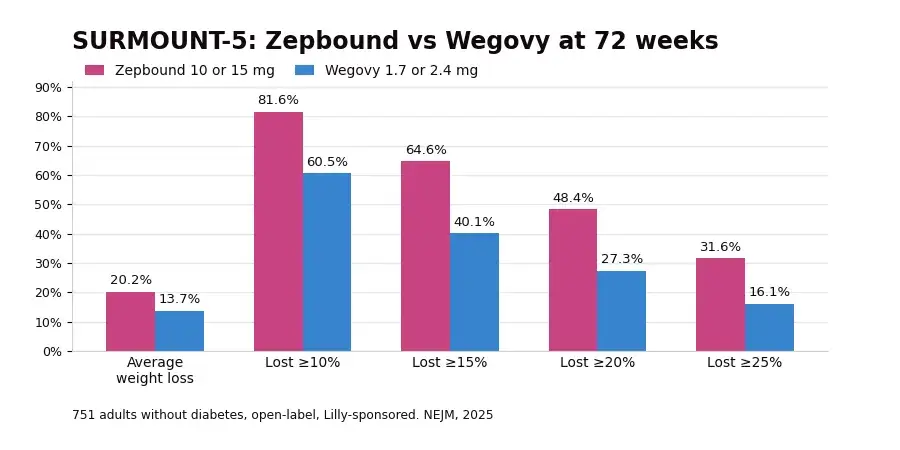
The primary result counts all randomized participants, including those who stopped treatment. Zepbound’s average loss was about 47% larger in relative terms, or 6.5 percentage points. Principal investigator Louis Aronne summed up the outcome when the data were released.
The SURMOUNT-5 head-to-head results demonstrated tirzepatide led to greater weight reduction compared to semaglutide.
Louis J. Aronne, MD, principal investigator, May 2025
What the responder rates mean
The averages hide a wide spread. About one in three people on Zepbound lost at least a quarter of their body weight, against about one in six on Wegovy. At the other end, about 18% of Zepbound users and about 40% of Wegovy users lost less than 10%. Those shares explain why some people do very well on the drug with the lower average. Others do less well on the drug with the higher one.
Limits of the trial
- It was open-label, so participants and investigators knew which drug was given.
- It tested Wegovy up to 2.4 mg, before the 7.2 mg Wegovy HD dose was approved.
- Lilly, the maker of Zepbound, sponsored it.
- It was not designed to compare safety between the two drugs.
- It excluded people with diabetes, who usually lose less weight on either drug.
Results in each drug’s own trials
Each drug also has its own pivotal trials against placebo. Those numbers are useful for the full dose range, though they come from separate studies and should not be ranked against each other directly.
| Drug and dose | Trial | Length | All participants counted | Participants who stayed on treatment |
|---|---|---|---|---|
| Zepbound 5 mg | SURMOUNT-1 | 72 weeks | 15.0% | 16.0% |
| Zepbound 10 mg | SURMOUNT-1 | 72 weeks | 19.5% | 21.4% |
| Zepbound 15 mg | SURMOUNT-1 | 72 weeks | 20.9% (placebo 3.1%) | 22.5% |
| Wegovy 2.4 mg | STEP 1 | 68 weeks | 14.9% (placebo 2.4%) | 16.9% |
| Wegovy HD 7.2 mg | STEP UP | 72 weeks | 18.8% (placebo 3.9%) | 20.7% |
Wegovy HD narrows the gap in these separate trials, with 18.8% against Zepbound’s 20.9% at the top dose. No trial has compared 7.2 mg Wegovy with 15 mg Zepbound, so the size of any remaining difference is unknown. For someone starting at 230 lb, the all-participant averages come to about 48 lb on Zepbound 15 mg and 43 lb on Wegovy HD. Wegovy 2.4 mg would average about 34 lb.
Zepbound vs Wegovy pill
Some people weigh Zepbound against the Wegovy tablet, on sale since January 2026. The two have never been tested in one trial. In separate trials counting all participants, the 25 mg pill produced 13.6% average loss over 64 weeks in OASIS 4. Zepbound 15 mg produced 20.9% over 72 weeks in SURMOUNT-1. Cash prices are $149 to $299 a month for the tablet and $299 to $449 per 28-day Zepbound fill. The tablet also comes with a daily fasting routine.
Dose steps and weekly schedules
Both drugs start low and rise every four weeks to limit nausea. Zepbound has more steps, so it takes longer to reach its top dose.
| Weeks | Wegovy | Zepbound |
|---|---|---|
| 1 to 4 | 0.25 mg | 2.5 mg |
| 5 to 8 | 0.5 mg | 5 mg |
| 9 to 12 | 1 mg | 7.5 mg |
| 13 to 16 | 1.7 mg | 10 mg |
| 17 to 20 | 2.4 mg, maintenance | 12.5 mg |
| 21 onward | 2.4 mg, or 7.2 mg after at least 4 weeks at 2.4 mg | 15 mg, or a lower maintenance dose |
For weight management, Zepbound can be held at 5, 10 or 15 mg. Wegovy’s is 2.4 mg or 1.7 mg, with 7.2 mg as an option for some adults. Each label allows the prescriber to slow the climb when a step causes side effects, and plenty of patients stop short of the top dose.
Missed doses and injection day
- Wegovy: a missed shot is still taken when over two days remain before the next one; with less time left, it is dropped. After two or more missed weeks, the label calls for restarting lower.
- Zepbound: a missed shot can be given within four days; after that it is dropped and the regular day resumes.
- Both: the injection day can be changed if enough time passes between doses, as each label sets out.
Storage, needles and supplies
- Wegovy single-dose pens have a built-in needle, so there is nothing extra to buy. Pens are refrigerated and can stay at room temperature for up to 28 days.
- Zepbound single-dose pens also have a built-in needle. Vials are drawn up with a syringe and the KwikPen takes screw-on pen needles, which are extra purchases.
- Zepbound belongs in the fridge too, with only a limited period outside it allowed by the label.
- For travel, both need a cool pouch on long trips, and a doctor’s note helps at airport security.
Side effects compared, from each label
Nausea, bowel changes and stomach pain top the list on both drugs, mostly in the early months and after each step up. Each pair of columns below is one drug’s label data next to its own placebo arm.
| Side effect | Wegovy 2.4 mg | Placebo | Zepbound 15 mg | Placebo |
|---|---|---|---|---|
| Nausea | 44% | 16% | 28% | 8% |
| Diarrhea | 30% | 16% | 23% | 8% |
| Vomiting | 24% | 6% | 13% | 2% |
| Constipation | 24% | 11% | 11% | 5% |
| Abdominal pain | 20% | 10% | 10% | 5% |
| Quit because of side effects | 6.8% | 3.2% | 6.7% | 3.4% |
In the label tables, digestive side effects were reported more often with Wegovy. SURMOUNT-5 pointed the same way, with fewer stops for digestive reasons on Zepbound. Because the label trials differed, the gaps are a guide for discussion, and individual tolerance varies widely on both drugs.
Effects specific to each drug
- Zepbound: redness or itching at the injection site was reported by 8% at 15 mg and 2% on placebo.
- Wegovy HD: in STEP UP, 22% on 7.2 mg noticed tingling, burning or extra-sensitive skin, compared with 6% on 2.4 mg.
- Both: side effects tend to fade after each dose step settles, and many people stay at a lower dose for that reason.
Warnings, contraindications and interactions
The two labels share their main warnings. Both open with the same boxed warning on thyroid C-cell tumors found in rodents. A personal or family history of medullary thyroid carcinoma or MEN 2 rules out either drug.
- Shared warnings: inflamed pancreas, gallbladder problems, kidney strain when fluids run low, hypoglycemia alongside insulin or sulfonylureas, and aspiration during sedation.
- Pregnancy: both should be stopped, and neither is recommended while breastfeeding.
- Oral contraceptives: the Zepbound label asks for a backup or non-oral method during the first 4 weeks and for 4 weeks after every step up.
- Eyes: semaglutide labels list diabetic retinopathy complications in people with type 2 diabetes, which matters mainly for patients with diabetes.
A pharmacist can check your current medicines against both labels in a few minutes, including supplements and over-the-counter products. That check is worth doing before the first prescription, especially for people on several daily drugs.
Approved uses and why they change coverage
The indications on each label decide more than medical fit. Insurers often cover a GLP-1 for a non-weight indication while excluding weight-loss drugs, so the list below can shape the cost.
- Wegovy: weight management in adults and teens aged 12 and older.
- Wegovy: fewer heart attacks, strokes and cardiovascular deaths in adults who already have heart disease, backed by the 20% risk cut seen in SELECT.
- Wegovy: noncirrhotic MASH with moderate to advanced liver scarring, under accelerated approval.
- Zepbound: weight management in adults.
- Zepbound: treatment of moderate-to-severe obstructive sleep apnea in adults with obesity, added in December 2024.

People with type 2 diabetes
Neither Wegovy nor Zepbound is the brand approved for diabetes. The same molecules are sold as Ozempic and Mounjaro for blood sugar control, at different doses. Weight loss on either molecule is usually smaller in people with diabetes, and SURMOUNT-5 did not include them. A prescriber treating both conditions may choose the diabetes brand, which plans more often cover.
For a teenager, only Wegovy is approved. A person with heart disease or fatty liver disease may find Wegovy covered under those indications, and a person with sleep apnea may find Zepbound covered. CMS confirmed in January 2025 that Part D plans can cover Zepbound for sleep apnea.
Self-pay cost: Wegovy vs Zepbound
On cash prices, Wegovy pens cost less at every stage. Both makers sell direct, Novo through NovoCare and Lilly through LillyDirect, at the prices below.
| Stage | Wegovy pen | Zepbound vial or KwikPen |
|---|---|---|
| Fill 1 | $199 (0.25 mg), new patients | $299 (2.5 mg) |
| Fill 2 | $199 (0.5 mg), new patients | $399 (5 mg) |
| Fill 3 onward | $349 (1 to 2.4 mg) | $449 (7.5 to 15 mg), refills within 45 days |
| Top dose | $399 (7.2 mg) | $449 (15 mg); $699 after a late refill |
| First year, standard steps to 2.4 mg or 15 mg | $4,237 | $5,637 |
| Later years at maintenance | $4,537 at 2.4 mg; $5,187 at 7.2 mg | $5,837 at 7.5 to 15 mg; $5,187 at 5 mg |

A Wegovy user climbing to 7.2 mg in the first year would pay about $4,637, still about $1,000 less than Zepbound on its standard path. Novo lists the two-fill intro price through the end of 2026. Neither price includes visit fees, and Zepbound vials and KwikPens need needles or syringes bought separately. Full Zepbound price rules, including vials and the 45-day refill window, are collected in our breakdown of Zepbound cost without insurance.
Cost per percentage point of weight loss
Dividing a year of maintenance by the SURMOUNT-5 averages gives a rough value comparison. Wegovy at $4,537 a year for 13.7% average loss works out to about $331 per point. Zepbound at $5,837 for 20.2% comes to about $289 per point. This is an average-based illustration, and your own response to either drug can differ widely.
Insurance, savings cards and the Medicare Bridge
Coverage often decides the choice before the trial data do. Plans list each brand separately, so one may be covered while the other is excluded.
- Commercial insurance: each maker’s savings card can bring a covered fill down to $25, and Lilly’s card applies to as many as 13 Zepbound fills a year.
- Plan exclusions: when weight-loss drugs are excluded, the heart, liver and sleep apnea indications may still open coverage for one drug.
- Medicare: eligible Part D members pay $50 a month under the GLP-1 Bridge until the end of 2027, for Wegovy pens or the Zepbound KwikPen. Zepbound vials and single-dose pens do not qualify.
- Medicaid: coverage depends on the state, and some programs list one drug and not the other.
When a plan covers one and not the other
Formularies change each year, and many plans pick one GLP-1 brand as preferred. A preferred drug may cost $25 with a savings card while the other costs the full cash price. In that case, the price gap between the two drugs can exceed $5,000 a year for the same patient. Ask the prescriber whether the covered drug is a reasonable choice for you before paying cash for the other. If it is not, a written denial and an appeal can be worth the paperwork.
Before choosing, check the formulary for both names and ask whether each requires prior authorization. A plan that covers one drug at $25 makes the cash comparison above irrelevant for that patient.
Choosing by coverage and price
Four common situations lead to different answers. The drug itself still has to suit your health, and these scenarios only describe where the cost lands.
- No insurance: Wegovy pens cost about $1,400 less in the first year on cash prices, while Zepbound produced more weight loss in SURMOUNT-5.
- Commercial plan covering one drug: the covered drug usually costs far less, often $25 with a savings card.
- Plan covering neither for weight: check the heart, liver and sleep apnea indications, which can open coverage for one drug.
- Medicare Part D: both are $50 a month through the Bridge if you qualify, with Zepbound limited to the KwikPen.
A lower-cost pill is another route for some people. Lilly sells Foundayo, a daily pill, at $149 to $299 a month. Wegovy also comes as a tablet from $149, and our Wegovy pill vs injection comparison sets out how it differs from the pen.
Who may lean toward each drug
These are the reasons that most often tip a patient and prescriber toward one injection. They describe fit only and say nothing certain about your own response.
Which injection fits you? Points to raise with your prescriber
Tick what applies to you. This tool lists discussion points only and does not recommend a drug.
Bring your ticked points and your medication list to the appointment.
Points that may favor Wegovy
- Existing heart disease, where Wegovy’s cardiovascular indication can support both treatment and coverage.
- Fatty liver disease with scarring, under the MASH indication.
- A teenager who needs treatment.
- A tighter cash budget, since Wegovy pens cost less at every stage.
- A wish to keep a pill option open later within the same brand.
Points that may favor Zepbound
- A bigger weight target, in light of SURMOUNT-5.
- Moderate-to-severe obstructive sleep apnea with obesity.
- Earlier digestive side effects on semaglutide.
- Plan coverage for Zepbound but not Wegovy.
Questions to bring to the appointment
- With my history, would either drug be a poor fit?
- Do my other conditions, such as heart disease, sleep apnea or fatty liver, favor one label?
- Which one is on my plan’s formulary, and will it need prior approval?
- What would a change of drug look like if the first one does not work out?
Switching between the two drugs is possible under a prescriber’s guidance. Since the molecules differ, the new drug normally begins at the bottom of its own dose ladder. That restart can bring back early side effects and early-step prices for a few months.
What happens if you stop
Weight tends to return after either drug is stopped. In an extension of STEP 1, those who came off semaglutide put back about two-thirds of their lost weight within twelve months. In SURMOUNT-4, people switched from tirzepatide to placebo regained about 14% of their body weight over the following year. Those who stayed on the drug lost a further 5.5%. Both drugs are labeled for long-term use, and a stop plan is worth discussing before starting.

What is still unknown
As of October 2026, several questions in this comparison were still open.
- Wegovy HD against Zepbound: no trial has compared 7.2 mg semaglutide with 15 mg tirzepatide.
- Heart outcomes for tirzepatide in people without diabetes: Zepbound has no cardiovascular indication, while semaglutide has SELECT.
- Long-term maintenance: both drugs have multi-year data, though people who stop either drug tend to regain weight, and the best long-term plan is still studied.
- 2027 prices: the Wegovy intro offer and Lilly’s savings card terms run through December 31, 2026, and both makers can change their ladders.
- Men and women: SURMOUNT-5 found about 6 points less weight loss in men than in women on both drugs, and the reasons are still being studied.
- Newer drugs: oral and next-generation injectables in late trials may change the choice within a few years.
None of these gaps is a mark against either drug. The picture will move as fresh trial data and new prices arrive. Approved options, prices and coverage are compared in our GLP-1 weight loss guide.
About this comparison: sources and disclosure
This comparison is written for adults in the US and does not replace medical advice. Facts were checked against the Wegovy and Zepbound prescribing information, Lilly’s SURMOUNT-5 release and the published NEJM results, and Novo Nordisk’s STEP UP release. We also used LillyDirect and NovoCare price pages and trackers checked in October 2026. Our primary sources were investor.lilly.com, www.novo-pi.com and lilly.com/lillydirect. Prices and program terms change every one to three months, so each figure carries its check month.
Affiliate disclosure: some buttons on this site lead to telehealth partners that may pay us a commission when you start a visit. These partners prescribe FDA-approved brand drugs only, and payments do not change the facts reported here.