
Does Medicare cover Zepbound? Yes, for many enrollees, along with Wegovy and Foundayo. Since July 1, 2026, the Medicare GLP-1 Bridge has covered all three for weight loss at $50 a month, through December 2027. To get it, you need drug coverage through Medicare, a BMI that meets the CMS tiers and a prior authorization from your prescriber.
Before July 2026, Medicare drug plans could cover these drugs only for other approved uses. Wegovy could be covered to lower heart attack and stroke risk or to treat liver disease called MASH. Zepbound could be covered for moderate-to-severe obstructive sleep apnea. Foundayo has no use besides weight management, so the Bridge is its only Medicare route.

In this guide
This guide sets out the coverage path for each drug and each diagnosis. It also explains what happens if you already take a GLP-1 through your plan, how Medicare Advantage fits in and what each route costs. Treat every answer here as a starting point to confirm with CMS and your prescriber.
Medicare coverage of GLP-1 drugs at a glance
The table answers the core question by drug and by the reason it is prescribed. Rules are as of October 2026, per CMS and Medicare materials.
| Drug and use | Medicare route | What you pay |
|---|---|---|
| Zepbound KwikPen for weight loss | GLP-1 Bridge, prior authorization | $50 a month |
| Zepbound vials or single-dose pens for weight loss | Not covered | Self-pay, $299 to $449 per 28 days |
| Zepbound for moderate-to-severe sleep apnea | Part D plan, if on its formulary | Plan cost-sharing |
| Wegovy pen or pill for weight loss | GLP-1 Bridge, prior authorization | $50 a month |
| Wegovy to cut heart attack and stroke risk | Part D plan, if on its formulary | Plan cost-sharing |
| Wegovy injection for MASH with liver scarring | Part D plan, if on its formulary | Plan cost-sharing |
| Foundayo for weight loss | GLP-1 Bridge, prior authorization | $50 a month |
| Ozempic, Mounjaro or Rybelsus for type 2 diabetes | Part D plan, standard coverage | Plan cost-sharing |
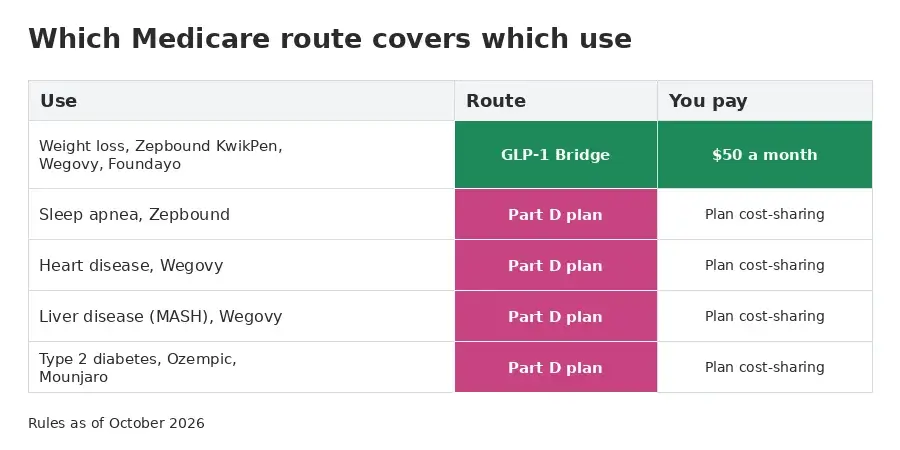
Two routes run side by side. The Bridge handles weight-loss prescriptions outside your plan, while the Part D plan handles every other approved use. A diagnosis that Part D can cover sends you to the plan, even if you also meet the Bridge criteria.
Find your Medicare route
Choose the drug, the reason it is prescribed and your coverage. This tool mirrors the CMS rules as of October 2026 and does not replace your prescriber’s review.
How Medicare coverage changed before and after July 2026
The Medicare Modernization Act of 2003 barred Part D plans from covering drugs used for weight loss. That rule still stands, and it explains why coverage depends so much on the diagnosis. Medicare could always pay for a GLP-1 when it was prescribed for diabetes, heart disease or another approved condition.
- November 2023: Zepbound is approved for chronic weight management, with no Medicare path for that use.
- March 2024: Wegovy gains a heart-risk indication, which Part D plans may cover.
- November 2024: the outgoing administration proposes covering obesity drugs under Part D from 2026.
- December 2024: Zepbound is approved for moderate-to-severe sleep apnea in adults with obesity.
- April 2025: CMS drops the proposal from its final 2026 rule.
- August 2025: Wegovy is approved for MASH with moderate to advanced liver scarring.
- November 2025: pricing deals with Novo Nordisk and Eli Lilly set the path to a $50 Medicare copay.
- April 2026: Foundayo, Lilly's daily pill, is approved for weight management.
- July 2026: the Medicare GLP-1 Bridge opens.
- December 2027: the Bridge is scheduled to end.
Articles written before December 2025 often say that Medicare will not cover weight-loss drugs in 2026. That was true of Part D itself, which still excludes them. The Bridge is a separate CMS demonstration, so those older answers miss the main change.
Does Medicare cover Zepbound?
Zepbound now has two Medicare paths, and the reason it is prescribed decides which one applies. Mounjaro, which contains the same drug, tirzepatide, is a third path for people with type 2 diabetes.
Zepbound for weight loss through the Bridge
Only the Zepbound KwikPen is on the Bridge list, at every strength from 2.5 to 15 mg. Single-dose vials and single-dose pens are excluded. A current vial user needs a new KwikPen prescription before the $50 price can apply. Each KwikPen holds four weekly doses, and pen needles are bought separately.
Zepbound for sleep apnea through Part D
The sleep apnea label covers adults with obesity and moderate-to-severe obstructive sleep apnea. Because that use is not weight loss, the Part D exclusion does not apply. Plans decide whether Zepbound sits on their formulary, and most require prior authorization. Typical requirements include the items below.
- A sleep study, in a lab or at home, showing moderate or severe obstructive sleep apnea.
- Obesity, usually a BMI of 30 or higher, recorded in your chart.
- A prescription written for sleep apnea, with diet and activity advice noted.
A person with moderate-to-severe sleep apnea cannot use the Bridge, even for a weight-loss prescription. Their Zepbound coverage stays with the Part D plan.
Mounjaro for type 2 diabetes
Most Part D plans cover Mounjaro, Ozempic or another GLP-1 for type 2 diabetes. A diabetes diagnosis also rules out the Bridge. Weight loss often follows on a diabetes brand, though the prescription and the coverage stay tied to blood sugar control.
Does Medicare cover Wegovy?
Does Medicare cover Wegovy? It does for weight loss through the Bridge, and for two other uses through Part D. Wegovy has the widest set of Medicare routes of the three brands.
Wegovy for weight loss
The Bridge covers all Wegovy formulations, including the weekly pen, the 7.2 mg high-dose pen and the daily tablet. The $50 copay stays flat across every dose. Wegovy for heart risk or MASH goes through the plan instead, as the next sections show.
Wegovy for heart disease
Wegovy is approved to lower the risk of heart attack, stroke and cardiovascular death in adults with heart disease and overweight or obesity. That label rests on the SELECT trial, which showed a 20% lower rate of major heart events against placebo. Part D plans may cover Wegovy for this use, with prior authorization and documented heart disease.
Wegovy for MASH
The MASH indication applies to noncirrhotic liver disease with moderate to advanced scarring, under accelerated approval. Part D can cover it, though plan adoption has been slower than for heart disease. A liver biopsy or imaging result is often requested.
Does Medicare cover the Wegovy pill?
Does Medicare cover Wegovy pill prescriptions? Yes, the tablet is on the Bridge list at the same $50 a month. It reached pharmacies in January 2026 and shares the pen's heart-risk label, so Part D can also cover it for heart disease if the plan lists it.
Does Medicare cover Foundayo?
Does Medicare cover Foundayo? Only through the Bridge, as of October 2026. Foundayo, the brand name for orforglipron, was approved in April 2026 for chronic weight management. That is its single indication, so a Part D plan has no other use under which it could cover the drug.
- Bridge coverage: all tablet strengths, $50 for a 30-day bottle, with prior authorization.
- No Bridge approval: self-pay through LillyDirect from $149 a month at the lowest dose.
- Savings cards: manufacturer coupons are closed to Medicare members and cannot lower the $50.
- Future change: a diabetes approval, if granted, would open a Part D route.
Foundayo is a daily pill that can be taken at any time of day, with or without food, which some older adults on several medicines find easier to fit in than a weekly shot or an empty-stomach tablet. Its doses climb from 0.8 mg to 17.2 mg over several months, and the Bridge copay stays at $50 through every step. A prescriber who files the request must name Foundayo on the form, since a Bridge approval is tied to one drug. The self-pay ladder and refill windows are covered in our guide to Foundayo cost.

Who qualifies for the $50 Bridge price
The Bridge sets clinical criteria stricter than the FDA labels. Your prescriber records your BMI and conditions as they were when you started a GLP-1, so later weight loss does not count against you. You must also be 18 or older.
| BMI at treatment start | Condition also required |
|---|---|
| 35 or higher | None |
| 30 or higher | Heart failure with preserved ejection fraction, hard-to-control high blood pressure, or kidney disease stage 3a or above |
| 27 or higher | Prediabetes, a past heart attack or stroke, or blocked arteries in the legs or arms |

Four conditions also apply to your coverage and diagnoses. You need Part D drug coverage, and your only coverage cannot be a special plan type. Your plan cannot already pay for a GLP-1 for you, and you cannot have type 2 diabetes, moderate-to-severe sleep apnea or fatty liver disease. The full approval process, the documents to gather and the timeline are on our Medicare GLP-1 Bridge page.
Does Medicare cover GLP-1 for weight loss if you fit none of these tiers? Not as of October 2026, so self-pay is the remaining route. KFF estimated that roughly 3.8 million enrollees meet the tiers, a small share of the 69 million-plus people covered by Medicare.
If you already take a GLP-1 for another condition
This is the area where answers online vary most, so it is worth checking with Medicare directly. The CMS rules themselves are clear on the main point. A June 2026 CMS memo to Part D plans is direct about anyone whose plan already pays for one.
currently receiving Part D coverage of a GLP-1 drug is not eligible.
CMS, Bridge expectations memo for Part D sponsors, June 2026
The same memo says anyone who received a GLP-1 through Part D during 2026 cannot join the Bridge that year, even with a new weight-management prescription. The Medicare fact sheet for enrollees puts it simply: plan users keep getting the drug through the plan. That holds whichever GLP-1 ingredient the plan covers, from semaglutide to dulaglutide.
Questions CMS materials leave open
Several situations are not settled in the documents CMS had published by October 2026. Guides online give different answers to them, so a call to 1-800-MEDICARE (1-800-633-4227) is the safest check.
- Stopping Part D coverage: whether someone whose plan stopped paying for a GLP-1 in 2026 can switch to the Bridge in 2027.
- Supplemental benefits: whether a Medicare Advantage weight-management benefit counts as plan coverage of a GLP-1.
- Earlier diagnoses: how a resolved condition, such as sleep apnea treated with surgery, affects the exclusion.
- Heart-risk prescriptions: CMS sends them to Part D, and whether a later weight-only prescription for the same person qualifies is unclear.
Keep a written record of what you are told, with the date and the representative's ID. If your plan's answer conflicts with Medicare's, ask the plan to put its position in writing.
Switching drugs mid-treatment
A patient on Ozempic for diabetes cannot move to Wegovy through the Bridge for a lower copay. The diabetes diagnosis keeps the coverage in Part D. A patient on Zepbound for sleep apnea is in the same position. Within the Bridge, a change of drug needs a new prior authorization, while a dose change on the same drug does not.
Medicare Advantage and other plan types
Medicare Advantage plans with drug coverage follow the same Part D rules for GLP-1 drugs. They can cover Zepbound for sleep apnea or Wegovy for heart disease if the drug is on their formulary. They cannot cover a GLP-1 for weight loss alone as a Part D drug. The Bridge runs through a central CMS processor, so your plan does not make the weight-loss decision.
| Coverage type | Bridge access |
|---|---|
| Standalone Part D plan | Yes |
| Medicare Advantage HMO, HMO-POS or PPO with drug coverage | Yes |
| Special Needs Plans and employer or union group plans | Yes |
| Private fee-for-service and cost plans | No |
| PACE | No |
| Original Medicare without a drug plan | No |
| Medicare Advantage plan with no drug coverage | No |
Medigap does not cover retail drugs, and Part B does not cover self-injected GLP-1s. Medicaid works under separate state rules, so people with both Medicare and Medicaid should ask their state program too. Changing plans during open enrollment, from October 15 to December 7, does not affect Bridge eligibility, since the Bridge is not tied to formularies.
What you pay under each route
Cost depends on which route covers you. The Bridge price is flat, while Part D cost-sharing varies by plan and by tier. Figures below are October 2026 amounts.
| Route | Monthly cost | Counts toward Part D cap | Extra Help applies |
|---|---|---|---|
| GLP-1 Bridge | $50 flat, every dose | No | No |
| Part D plan, covered use | Deductible up to $615, then plan copay or coinsurance | Yes, $2,100 cap in 2026 | Yes |
| Self-pay, Foundayo or Wegovy pill | $149 to $299 | No | No |
| Self-pay, Wegovy pen | $199 intro, then $349 | No | No |
| Self-pay, Zepbound vial or KwikPen | $299 to $449 per 28 days | No | No |
The Part D cap rises to $2,400 in 2027. Once you reach it, covered drugs cost nothing for the rest of the year. Someone on several expensive medicines may hit the cap early in the year, which can make a covered Part D route cheaper than the flat $50 Bridge copay when you add up all twelve months.
Negotiated semaglutide prices from 2027
Medicare negotiated a price of $274 for a 30-day supply of semaglutide, announced in November 2025. It applies to Ozempic, Wegovy and Rybelsus from January 2027, against a 2024 list price of $959. The negotiated price lowers what plans pay, and your plan still sets your copay. It does not change the Bridge's $50.
What the $50 leaves out
- Pen needles for the Zepbound KwikPen are billed separately.
- The Medicare Prescription Payment Plan cannot spread Bridge copays over the year.
- Visits, labs and sleep studies follow your normal Part B cost-sharing.
- Telehealth visit fees, if you use an online prescriber, are paid on top.
Self-pay prices and refill windows for each dose are set out in our guide to Zepbound cost without insurance.
How to check your coverage step by step
The steps below work for any of the three drugs. They take a few phone calls and one appointment.
- Confirm your drug coverage. Your Medicare card and plan card show whether you have Part D or a Medicare Advantage drug plan.
- Name your diagnoses. List type 2 diabetes, sleep apnea, MASH and heart disease if any apply, since each one changes the route.
- Check the formulary for covered uses. Your plan's drug list and prior authorization rules are on its website or by phone.
- Check the Bridge criteria. Find your BMI when you started a GLP-1, or today's BMI if you have not started.
- Ask your prescriber which route fits. They file either the plan's prior authorization or the Bridge request.
- Wait for the decision. CMS aims to decide Bridge requests within 72 hours, and Medicare sends a letter confirming coverage.
- Fill at a pharmacy that can bill the Bridge, and pay $50 for the month's supply.
If you use an online prescriber, ask early whether they file Bridge requests and accept Medicare, since some services only take cash and cannot submit the CMS form at all. Their visit fees also sit outside both the Bridge copay and the Part D cap.
If Medicare says no
A refusal means different things on each route. The Bridge has no appeal process, while Part D has a formal one with fixed deadlines.
Bridge denials
Your prescriber can resubmit the request with fuller records. Common gaps include a missing BMI from the start of treatment or no lab result showing prediabetes. A denial that cites diabetes, sleep apnea or fatty liver disease means the request belongs with your Part D plan.
Part D denials
You can ask the plan for a coverage determination, then a redetermination within 65 days of the denial notice. Your prescriber can also request a formulary exception with a statement of medical need. A second refusal can go to an independent review entity. Keep every notice, since each deadline runs from its date.
Paying without Medicare
Manufacturer cash prices stay open to Medicare members, even though savings cards do not. Self-pay does not count toward the Part D cap. The lowest prices for each brand are compared in our look at cash prices. The two injections are set side by side in our injection comparison.
Common mix-ups about Medicare and GLP-1 drugs
Questions such as does Medicare pay for GLP-1 drugs often get mixed answers because several rules overlap. The points below clear up the most frequent errors.
- Ozempic for weight loss: Part D covers Ozempic for diabetes only, and the Bridge does not include it.
- Compounded drugs: compounded semaglutide and tirzepatide are not covered by Part D or the Bridge.
- Part B: Medicare Part B does not cover GLP-1 drugs you inject or swallow at home.
- Bridge and Part D are the same: the Bridge sits outside your plan and has its own rules and price.
- A deal set a $50 copay for everyone: the $50 applies only to approved Bridge enrollees.
- Foundayo is investigational: it has full FDA approval for weight management, dated April 2026.
Does Medicare cover GLP-1 drugs in every case, then? No, the answer still depends on the drug, the diagnosis and the plan type. For an overview of how these brands differ in results and side effects, see our GLP-1 weight loss guide.
About this guide: Medicare sources and disclosure
This guide is for Medicare enrollees and caregivers in the US and does not replace medical or benefits advice. We checked coverage rules against the official Medicare Bridge fact sheet and the June 2026 CMS memo to Part D plans. Negotiated prices come from reporting on CMS's November 2025 announcement. Our primary sources were www.medicare.gov, kffhealthnews.org, www.healthcaredive.com and www.cms.gov. Self-pay prices are manufacturer prices checked in October 2026, and rules can change before the Bridge ends.
Affiliate disclosure: some buttons on this site lead to telehealth partners that may pay us a commission when you start a visit. These partners prescribe FDA-approved brand drugs only, and payments do not change the facts reported here.