
The Medicare GLP-1 Bridge program is a temporary CMS demonstration that gives eligible Medicare enrollees Wegovy, Zepbound or Foundayo for weight loss at $50 a month. It runs from July 1, 2026, to December 31, 2027, and operates outside the regular Part D benefit. You need Part D or a Medicare Advantage drug plan, a qualifying BMI with any required health condition, and a prior authorization filed by your prescriber. There is no separate application, and the $50 does not count toward the Part D out-of-pocket cap.
This guide explains who qualifies under the CMS criteria and which drugs and forms are covered. It walks through the approval step by step and shows what the $50 copay leaves out. It also covers what to do if you do not qualify. The prescriber who files the request also decides, with you, whether a GLP-1 drug suits your health.
In this guide
What the Medicare GLP-1 Bridge is
Since Part D began in 2006, the law has barred Medicare drug plans from covering medicines used only for weight loss. The Bridge works around that rule as a demonstration run directly by CMS. Drug plans do not opt in and carry no financial risk, and a central processor handles the approvals and pharmacy claims.
| Feature | Detail |
|---|---|
| Dates | July 1, 2026, through December 31, 2027 |
| Who runs it | CMS, through a central processor, outside Part D plans |
| Copay | $50 for a one-month supply, flat at every dose |
| Covered drugs | Wegovy injection and tablets, Foundayo, Zepbound KwikPen |
| Who can use it | Adults 18 and older with Part D or a Medicare Advantage drug plan who meet the clinical criteria |
| How you get in | Prior authorization submitted by the prescriber |
| Decision time | Within 72 hours of submission, per CMS |
| Appeals | None; a request can be resubmitted with more information |
The GLP-1 Bridge program Medicare launched in July 2026 was first planned for six months. It was meant as a lead-in to a longer program called BALANCE, which would have shifted costs to insurers. Too few insurers signed up by the April 2026 deadline, so CMS extended the Bridge to 18 months. What follows it in 2028 had not been announced as of October 2026.
Why the program exists
About 40% of American adults have obesity, according to the CDC, and the share is similar among people approaching Medicare age. KFF polling found that about half of GLP-1 users found the drugs hard to afford, and a quarter very hard. Before the Bridge, a Medicare enrollee who wanted a GLP-1 for weight alone paid the full cash price. The program is the first time Medicare has paid for a drug prescribed specifically to treat obesity.
Which drugs and forms are covered
The Bridge covers three brands for weight reduction, with one limit on Zepbound forms. The list below follows CMS’s provider page.
- Wegovy: all formulations, including the weekly injection, the 7.2 mg high-dose pen and the daily tablet.
- Foundayo: all tablet strengths of Lilly’s daily pill.
- Zepbound: the KwikPen only. Single-dose vials and single-dose pens are excluded.
- Not covered: pen needles, Ozempic and Mounjaro, compounded semaglutide or tirzepatide, and other weight-loss drugs.
Within each brand, the $50 covers every dose the prescriber writes. Foundayo runs from 0.8 to 17.2 mg and the Wegovy tablet from 1.5 to 25 mg. The Wegovy pen covers 0.25 to 2.4 mg plus the 7.2 mg high dose, and the Zepbound KwikPen 2.5 to 15 mg. Choosing between them is a clinical decision based on trial results, side effects, daily routine and other medicines. The copay does not favor one drug over another.
The KwikPen rule matters for current Zepbound users. A patient on vials who wants the $50 price needs a new prescription for the KwikPen form. Pen needles are billed separately and cannot go through the Bridge.
Who qualifies: the CMS eligibility criteria
Medicare GLP-1 Bridge eligibility criteria rest on BMI and specific health conditions. The prescriber attests that the drug is prescribed for weight reduction and maintenance alongside lifestyle changes. The attestation also confirms that you met one of the tiers below when you started a GLP-1.
| BMI at GLP-1 start | Additional condition required |
|---|---|
| 35 or higher | None |
| 30 or higher | Heart failure with preserved ejection fraction; high blood pressure above 140/90 despite two medicines; or chronic kidney disease stage 3a or higher |
| 27 or higher | Prediabetes by ADA criteria; a prior heart attack; a prior stroke; or peripheral artery disease with symptoms |
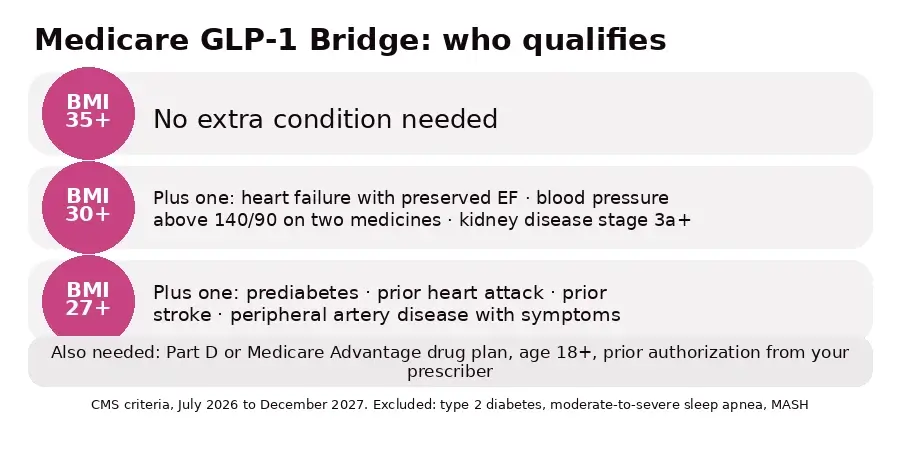
A KFF analysis estimated that about 3.8 million Medicare beneficiaries meet these criteria, out of more than 69 million people on Medicare. The tiers are stricter than the FDA labels, which start at a BMI of 27 with any weight-related condition.
Check your eligibility for the Medicare GLP-1 Bridge
Answer for the time you first started a GLP-1, or for today if you have not started. This tool mirrors the CMS criteria and does not replace your prescriber’s review.
Conditions you have been diagnosed with
Medicare Advantage and standalone drug plans
Both standalone Part D plans and Medicare Advantage plans with drug coverage qualify. Your plan does not decide Bridge approvals, since the program runs outside it, and you keep paying your usual plan premium. If you have Original Medicare without a drug plan, you would need to join one first. Joining Part D late can bring a lifelong late-enrollment penalty, which is worth weighing before signing up only for the Bridge.
If you already take a GLP-1
Eligibility is judged at the start of treatment, so earlier weight loss does not disqualify you. That applies even if therapy began before you joined Part D or before July 1, 2026. Your prescriber needs to document the BMI and conditions you had when the drug was first started, so old records from a previous doctor can matter.
Who is excluded from the Bridge
Some groups cannot use the Bridge, often because Part D already covers a GLP-1 for them. The exclusions below come from CMS and from KFF’s review of the program.
- People with type 2 diabetes, moderate-to-severe obstructive sleep apnea or noncirrhotic MASH. Their GLP-1 coverage goes through the regular Part D plan.
- Prescriptions written to reduce heart attack and stroke risk. Those also go to the Part D plan, even when the patient meets Bridge criteria.
- Enrollees who already filled a GLP-1 through Part D in 2026.
- Medicare beneficiaries without Part D or a Medicare Advantage drug plan. TRICARE for Life drug coverage does not qualify.
- Anyone under 18.
Being excluded from the Bridge does not always mean paying full price. A person with diabetes, sleep apnea or established heart disease may get a GLP-1 through the Part D plan under that diagnosis, at the plan’s own cost-sharing.
What the $50 copay covers and what it does not
The $50 is a flat charge per one-month supply. It stays the same as the dose rises, and you do not have to meet a deductible first. The fine print matters most for people on several other medicines.
- The $50 does not count toward the Part D deductible.
- It does not count toward the Part D out-of-pocket cap, which is $2,100 in 2026 and rises to $2,400 in 2027.
- Extra Help, the low-income subsidy, does not apply. Enrollees who normally pay $5.10 for generics and $12.65 for brands still pay $50.
- Manufacturer coupons and savings cards cannot lower the $50 further.
- The copay cannot be spread out through the Medicare Prescription Payment Plan.
KFF’s Juliette Cubanski noted that even $50 is a real expense for many older adults.
A lot of money for somebody who’s living on a $750-a-month Social Security check.
Juliette Cubanski, KFF Program on Medicare Policy, May 2026
What the Bridge saves in a year
The table compares a year under the Bridge with manufacturer cash prices on the standard dose path. Pills come in 30-day bottles, and injections in 28-day fills, so a year takes 12 or 13 fills.
| Drug | Bridge, one year | Self-pay, first year | Approximate saving |
|---|---|---|---|
| Foundayo | $600 (12 bottles) | $3,188 | $2,588 |
| Wegovy pill | $600 (12 bottles) | $3,338 | $2,738 |
| Wegovy pen, to 2.4 mg | $650 (13 fills) | $4,237 | $3,587 |
| Zepbound KwikPen | $650 (13 fills) | $5,637 | $4,987 |
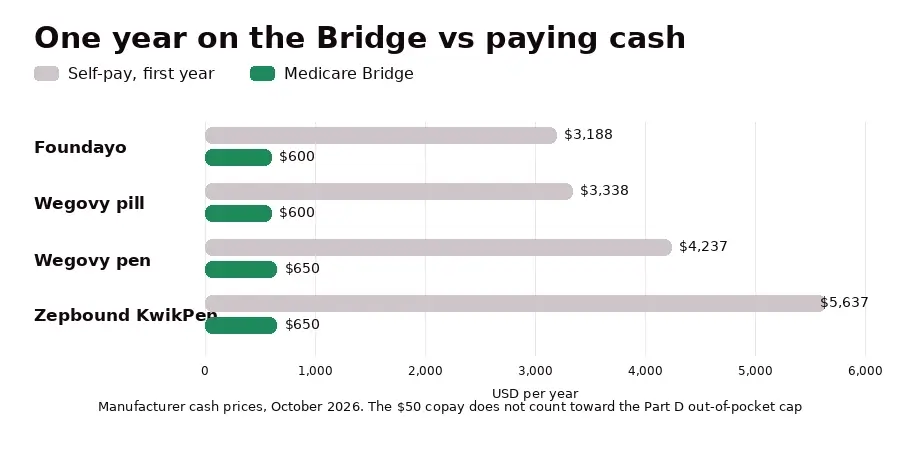
Over the full 18 months, a pill user would pay about $900 in copays. Self-pay ladders and their refill rules are covered in our guides to Foundayo cost and Zepbound cost without insurance.
How to enroll in the Medicare GLP-1 Bridge program
Learning how to enroll in Medicare GLP-1 Bridge program coverage starts with one fact: you do not sign up for the Bridge yourself. Enrollment happens through your prescriber and your pharmacy, in the order CMS sets out for providers.
- Confirm your coverage. You need an active Part D plan or a Medicare Advantage plan with drug coverage. 1-800-MEDICARE can confirm it.
- Check the criteria. Gather your BMI at the start of treatment and records of any qualifying condition, such as prediabetes or a past heart attack.
- See a prescriber. The clinician does not need to be enrolled in Medicare, though they must not be on Medicare’s preclusion list.
- Prescriber sends the prescription to your pharmacy first. Submitting the authorization before a pharmacy claim exists returns a “patient not found” error.
- Pharmacy runs the claim, and that claim prompts the pharmacy to ask the prescriber for authorization, usually within 24 to 72 hours.
- Prescriber submits the Bridge prior authorization, electronically through the ePA portal or by fax on the CMS form, and attests to the criteria.
- Decision arrives within 72 hours. It is mailed to you and sent to the prescriber.
- Pharmacy fills the prescription, and you pay $50 for the month’s supply.
The whole process can take a few days to about a week. Ask the pharmacy before you go whether it is set up to bill the Bridge, since the claim runs outside your usual drug plan.
The prior authorization form
The Medicare GLP-1 Bridge prior authorization form is a CMS document for prescribers, not patients. It asks for the drug and strength, the BMI at the start of treatment and the qualifying condition, plus an attestation signed under penalty of perjury. CMS may check the answers against Medicare data. CMS strongly encourages electronic submission over fax.
Telehealth prescribers and the Bridge
Because the prescriber does not have to be a Medicare-enrolled provider, a licensed clinician from a telehealth service can file the request. The service must be willing to complete the Bridge paperwork. Ask before booking whether its clinicians file Bridge requests and whether that work carries an extra fee.
Documents to bring to the appointment
Most delays come from missing proof of the BMI tier or the qualifying condition. The checklist below covers what prescribers usually need for the attestation.
- Your weight and height when you first started a GLP-1, or today if you are starting now.
- Blood pressure readings showing levels above 140/90 while on two medicines, if that is your qualifying condition.
- Kidney test results showing chronic kidney disease stage 3a or higher.
- An echocardiogram or cardiology note confirming heart failure with preserved ejection fraction.
- A lab result in the prediabetes range, such as an A1C of 5.7% to 6.4%.
- Hospital or specialist records of a prior heart attack or stroke, or a test confirming peripheral artery disease.
- Your Medicare and Part D cards, a full medication list and any pharmacy records of earlier GLP-1 fills.
Bringing copies saves a round of requests between offices. A prescriber who has these records on file can usually submit the authorization the same day the pharmacy asks for it.
If your request is denied
The Bridge has no formal appeals process. A denial is mailed to you and sent to the prescriber, who can resubmit with corrected or added information.
- Check the reason first. Common gaps are a missing BMI at the start of treatment or a condition that was not documented.
- Ask the prescriber to resubmit with records, such as a past lab result showing prediabetes or a hospital note from a prior heart attack.
- Call the Bridge call center at 855-273-0102, Monday to Friday, 8 a.m. to 7 p.m. Eastern, for questions on a request’s status.
- Go to Medicare for problems with the Bridge, not to your drug plan. AARP’s Leigh Purvis put it simply: “You do not go to your plan.”

A denial for type 2 diabetes, sleep apnea or MASH usually means the request belongs in Part D. In that case the prescriber files with your drug plan instead. Part D plans do have a formal appeals process, so a refusal there can be challenged in writing. Keep copies of every notice, since the dates on them matter for any appeal or resubmission.
Staying on the Bridge month to month
Getting approved is only the first step. A few rules shape what happens over the following months.
- Dose increases: the $50 stays the same as you climb the dose ladder, and the prescriber sends each new strength to the pharmacy.
- Pharmacy changes: a new pharmacy must also be able to bill the Bridge, so check before you move a prescription.
- Plan changes: switching Part D plans during open enrollment can affect your other drugs. Compare the whole plan before changing for any one medicine.
- Regular supplies: refill on time, since a missed month can mean restarting at a lower dose on medical grounds.
Safety checks that matter more after 65
- Fluids: vomiting or diarrhea can cause dehydration, and the labels warn about kidney injury, which older adults face more often.
- Diabetes medicines: insulin and sulfonylureas can push blood sugar too low when combined with a GLP-1, so doses may need adjusting.
- Procedures: GLP-1 drugs slow stomach emptying, so surgeons and anesthesia teams need to know before any sedation.
- Thyroid history: medullary thyroid carcinoma or MEN 2 in you or a close relative rules these drugs out.
- Gallbladder and pancreas: severe upper abdominal pain needs prompt medical attention.
A pharmacist can review the full medication list at the first fill, which helps when a person takes several daily medicines.

Planning for December 31, 2027
Coverage under the Bridge ends with 2027 unless CMS or Congress acts. Cubanski told CBS News that, after the temporary program, there is “no clear path forward yet” for coverage. Anyone starting in 2026 should plan with the prescriber for what happens if the program ends. That plan covers self-pay costs and the weight regain that often follows stopping these drugs.
If you do not qualify: other routes
Many Medicare enrollees will not meet the Bridge criteria. Several other routes remain, and the right one depends on your diagnoses and budget.
- Part D under another diagnosis: type 2 diabetes, established heart disease, sleep apnea or MASH can open GLP-1 coverage through the drug plan.
- Self-pay: manufacturer cash prices start at $149 a month for Foundayo and the Wegovy pill, and $299 per 28 days for Zepbound vials and KwikPens.
- Medicaid: people with both Medicare and Medicaid should check state coverage, since about 13 state programs covered GLP-1s for obesity in January 2026.
- Employer or retiree plans: some retiree drug plans follow their own rules, so ask the plan directly.
Self-pay runs outside insurance, so it does not count toward the Part D cap either. Manufacturer savings cards are closed to Medicare members, while the cash price stays available to them. Visit fees from a telehealth service come on top of the drug price.
Helping a parent or partner enroll
Caregivers often handle the paperwork, and a few steps make it smoother. Medicare speaks to a caregiver once the enrollee names them as an authorized contact, which can be set up by phone through 1-800-MEDICARE. Gather the medical records listed above before the appointment, and confirm the pharmacy can bill the Bridge. State Health Insurance Assistance Programs offer free one-on-one Medicare counseling and can help compare the Bridge with Part D options.
Medicare GLP-1 coverage in 2026: how the pieces fit
Coverage of Medicare weight loss drugs now runs through three separate channels, depending on why the drug is prescribed. The table shows which channel applies.
| Reason for the prescription | Channel | Typical cost to you |
|---|---|---|
| Weight loss, meeting Bridge criteria | GLP-1 Bridge | $50 a month |
| Type 2 diabetes | Part D plan (Ozempic, Mounjaro, Rybelsus and others) | Plan cost-sharing, counts toward the $2,100 cap |
| Heart-risk reduction with established heart disease | Part D plan (Wegovy) | Plan cost-sharing, counts toward the cap |
| Moderate-to-severe sleep apnea with obesity | Part D plan (Zepbound) | Plan cost-sharing, counts toward the cap |
| Weight loss, not meeting Bridge criteria | Self-pay outside insurance | $149 to $449 a month at manufacturer prices |
Part D cost-sharing can be higher than $50 in some months. It does count toward the yearly cap, which can make Part D cheaper over a full year for someone on several expensive drugs. A pharmacist or a State Health Insurance Assistance Program counselor can compare the two for your situation at no charge.
Three example enrollees
The cases below show how the criteria and the costs play out. They are illustrations built from the CMS rules and October 2026 prices, not advice for any individual.
BMI 31 with uncontrolled blood pressure
A 68-year-old with a BMI of 31 has blood pressure above 140/90 despite two medicines. That meets the BMI 30 tier. With a Foundayo prescription approved through the Bridge, a year of 30-day bottles costs $600, against about $3,188 at self-pay prices on the standard dose path.
BMI 29 with type 2 diabetes
A 72-year-old with a BMI of 29 has type 2 diabetes. The diabetes excludes them from the Bridge, so a GLP-1 goes through the Part D plan instead, usually a diabetes brand such as Ozempic or Mounjaro. Their cost-sharing follows the plan’s tiers, and it counts toward the $2,100 cap in 2026.
BMI 33 with no qualifying condition
A 66-year-old with a BMI of 33 has no listed condition. At that BMI, the Bridge requires one of the tier-two conditions, so this person does not qualify. Self-pay remains open, from $149 a month for a pill, and a later diagnosis could change eligibility.
What is still unknown about the Bridge
Several questions about the program had no answer in October 2026.
- What replaces it in 2028: the BALANCE model’s Part D phase was delayed, and no successor was confirmed.
- Total cost: CMS had not published spending or enrollment projections.
- Uptake: how many of the 3.8 million estimated eligible people will enroll, and how pharmacies handle the volume.
- Long-term results in older adults: most trials enrolled younger adults, and data on people over 75 remain limited.
- Approval length: CMS materials did not state how long an approval lasts or whether a renewal is needed before December 2027.
- Pharmacy readiness: not every pharmacy was set up to bill the Bridge in its first months, and access in rural areas is still being tracked.
- Out-of-pocket rules: whether any successor program would count copays toward the Part D cap is unknown.
These open points do not change how the program works today. They mean the rules may shift before 2028, and we will update this page once CMS publishes new terms. Approved drugs and their prices are compared side by side in our GLP-1 weight loss guide.
About this guide: sources and disclosure
This guide is written for Medicare enrollees and caregivers in the US and does not replace medical or benefits advice. Facts were checked against CMS’s provider page and educational materials for the Medicare GLP-1 Bridge and KFF Health News reporting with KFF policy analysis. We also used published reporting on Extra Help and the Part D cap. Prices come from manufacturer self-pay ladders checked in October 2026. Our primary sources were www.cms.gov, kffhealthnews.org and www.hhs.gov. Program terms can change, so each figure carries its check date.
Affiliate disclosure: some buttons on this site lead to telehealth partners that may pay us a commission when you start a visit. These partners prescribe FDA-approved brand drugs only, and payments do not change the facts reported here.