
Wegovy pill vs injection is a choice between two forms of the same drug, semaglutide, made by Novo Nordisk. The pill is a 25 mg tablet taken every morning on an empty stomach. The injection is a weekly shot at 2.4 mg, or 7.2 mg as Wegovy HD. In separate trials, average weight loss was 13.6% with the pill over 64 weeks and 14.9% with the 2.4 mg shot over 68 weeks. As of October 2026, the pill costs $149 to $299 a month on self-pay, and the standard pen $199 to $349 per 28 days.
No trial has compared the two forms directly in the same people. The figures below are each form’s own result against placebo, with the counting method named for every number. Routine, other medicines, approved uses, coverage and budget all shape the better fit, and the final call is made with your prescriber.
In this guide
Wegovy pill vs injection at a glance
Both forms deliver the same molecule and share a boxed warning, the main side effects and the heart-risk indication. They differ in how the drug enters the body, the daily routine and the list of approved uses.
Separate trials, no head-to-head comparison; all-participant estimates shown. Labels revised June 2026 and NovoCare prices as of October 2026.
The pill reached US pharmacies in January 2026, after FDA approval in December 2025. The 2.4 mg injection has been on the market since 2021, and Wegovy HD was approved in March 2026. That gap explains why the injection has a longer track record and more approved uses.
Same molecule, two routes into the body
Semaglutide is a peptide, and the stomach normally breaks peptides down, so the Wegovy pill form needed a different design from the shot. The two forms solve that problem in different ways, which shapes the dose sizes and the rules for taking them.
- Under the skin, about 89% of each semaglutide dose reaches the bloodstream, according to published label data.
- Taken by mouth, only about 1% of each tablet is absorbed. An absorption enhancer called SNAC protects a small share of the dose in the stomach.
- That difference is why the top tablet is 25 mg while the standard shot is 2.4 mg, roughly ten times less.
- Once absorbed, the drug behaves the same way. Semaglutide has a half-life of about one week by either route.
The low absorption also explains the strict morning rules. Food, coffee or other pills in the stomach cut the small absorbed share further, so the label requires an empty stomach and a 30-minute wait.
Is the Wegovy pill as effective as the shot?
On Wegovy pill vs injection effectiveness, the two produced similar average weight loss in their own trials, though the trials differed in length, size and dose. The table shows each result with the trial name and counting method, as the published data report them.
| Form and dose | Trial | Length | All participants counted | Participants who stayed on treatment |
|---|---|---|---|---|
| Pill, 25 mg daily | OASIS 4, 307 adults | 64 weeks | 13.6% (placebo 2.2%) | 16.6% (placebo 2.7%) |
| Injection, 2.4 mg weekly | STEP 1, 1,961 adults | 68 weeks | 14.9% (placebo 2.4%) | 16.9% (placebo 2.4%), per the trial paper |
| Injection, 2.4 mg weekly | STEP UP, comparison arm | 72 weeks | 15.5% | 17.5% |
| Injection, 7.2 mg weekly (HD) | STEP UP, 1,407 adults in total | 72 weeks | 18.8% (placebo 3.9%) | 20.7% (placebo 2.4%) |
Read like for like, the 25 mg pill and the 2.4 mg shot sit about 1.3 percentage points apart when all participants are counted. That gap is small next to the differences in trial design. The 7.2 mg dose produced more loss than 2.4 mg in the same trial, so for Wegovy HD the comparison with the 2.4 mg arm is direct.
Why sources quote different numbers
Each trial reports two estimates. One includes every randomized participant, even those who quit treatment, and the other estimates the result if everyone took the drug as directed. Articles that quote 16.6% for the pill and 14.9% for the shot mix the two methods, which reverses the apparent ranking.
For someone who starts at 230 lb, the averages come to about 31 lb with the pill and 34 lb with the 2.4 mg shot. The 7.2 mg average would be about 43 lb. Results varied a lot from person to person in each trial, with some losing far more and others far less.
When each form reaches full strength
The pill reaches its 25 mg maintenance dose on day 91, and the 2.4 mg injection in week 17. Weight loss builds gradually on both forms and kept increasing for most of each trial. Comparing early results between a friend on the pill and a friend on the shot therefore says little, since their dose steps run on different calendars. Most prescribers judge the response after several months at the maintenance dose.
Trial investigators commented strongly on the 7.2 mg result when the FDA approved it in March 2026. One of them, endocrinologist Timothy Garvey of the University of Alabama at Birmingham, described its possible effect on clinical practice in these words.
Could reshape healthcare professionals’ expectations about what outcomes are possible for their patients.
W. Timothy Garvey, MD, University of Alabama at Birmingham, March 2026
Dosing schedules and time to maintenance
Both forms start low and rise in steps to limit nausea. The pill moves monthly and reaches maintenance in the fourth month, while the shot moves every four weeks and reaches maintenance in week 17.
| Period | Pill, daily | Injection, weekly |
|---|---|---|
| Month 1 / weeks 1 to 4 | 1.5 mg | 0.25 mg |
| Month 2 / weeks 5 to 8 | 4 mg | 0.5 mg |
| Month 3 / weeks 9 to 12 | 9 mg | 1 mg |
| Month 4 / weeks 13 to 16 | 25 mg, maintenance | 1.7 mg |
| Week 17 onward | 25 mg | 2.4 mg or 1.7 mg maintenance, with 7.2 mg as a later option |
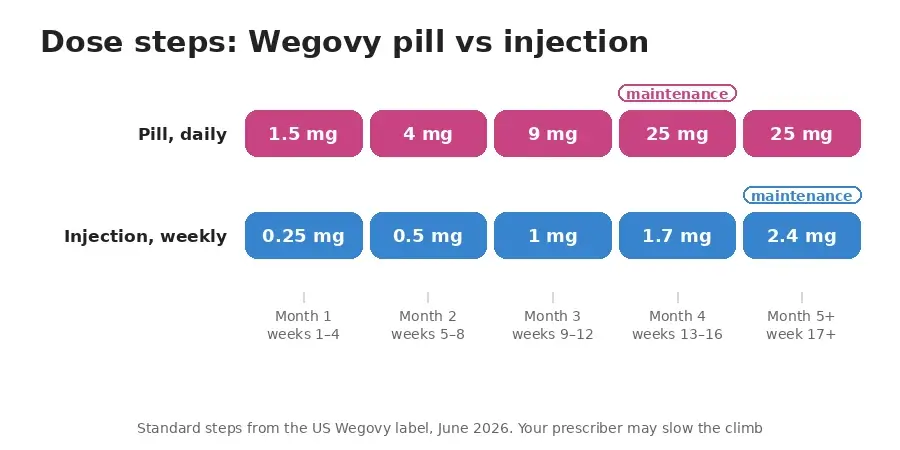
If a step brings on side effects, either label allows the prescriber to slow the climb. A prescriber may hold a dose for longer, and some injection users stay at 1.7 mg for maintenance.
Daily routine: morning rules or one injection day
The routine is where most people feel the difference. The pill asks for a few minutes every morning, and the shot asks for a few seconds once a week.
Taking the pill
- On waking, before anything else, take one tablet on an empty stomach.
- Swallow it whole, using plain water only and 4 ounces at most.
- Wait at least 30 minutes before food, other drinks or other oral medicines.
Taking the injection
- Give the shot under the skin of the belly, thigh or upper arm, keeping to one weekday.
- Food and time of day do not matter.
- The day can be moved if at least two days pass between doses.

Fitting the pill around other medicines
The 30-minute rule covers every oral medicine, which is the part of the routine people most often underestimate. Blood pressure tablets, vitamins and thyroid medicine all have to wait until the window has passed. Levothyroxine is the classic conflict, since it is also usually taken on an empty stomach in the morning. A pharmacist can draw up a new schedule, for example moving some tablets to lunch or bedtime. The injection has no such rule, so morning medicines stay where they are.
Missed doses
- Pill: leave out the missed tablet and resume with the next morning’s dose.
- Injection: take the missed dose if the next one is more than two days away. Otherwise skip it and keep the usual day.
- Injection: after two or more missed weeks in a row, the label calls for restarting at a lower dose, as the prescriber directs.

Side effects compared
Stomach and bowel complaints lead the side-effect list for both forms, and they peak early and around each step up. According to the tablet label, its side-effect pattern matched the 2.4 mg shot. Each column pair below comes from that form’s own program.
| Measure | Injection 2.4 mg | Placebo | Pill 25 mg | Placebo |
|---|---|---|---|---|
| Nausea | 44% | 16% | 46.6% | 18.6% |
| Vomiting | 24% | 6% | 30.9% | 5.9% |
| Diarrhea | 30% | 16% | Similar per label | Not in the release |
| Constipation | 24% | 11% | Similar per label | Not in the release |
| Quit because of side effects | 6.8% | 3.2% | 6.9% | 5.9% |
The rates are close, and the trials differ, so the gaps are a guide and not a measured difference. Wegovy HD adds one effect worth knowing. In STEP UP, skin-sensation changes such as tingling or sensitive skin affected 22% of people on 7.2 mg, against 6% on 2.4 mg and 0.3% on placebo.
Easing stomach side effects on either form
- Eat smaller meals and stop at the first sign of fullness.
- Limit fatty and fried foods during dose increases.
- Drink fluids through episodes of vomiting or diarrhea to protect the kidneys.
- Ask the prescriber whether to stay on the current dose a while before stepping up.
Shared warnings
- The same boxed warning on thyroid C-cell tumors from rodent studies. Anyone with a personal or family history of medullary thyroid carcinoma or MEN 2 should use neither form.
- Cautions on pancreatitis, gallbladder disease, dehydration-related kidney problems and hypoglycemia when combined with insulin or sulfonylureas.
- Advice to stop treatment in pregnancy.
- For the pill only, closer monitoring of oral drugs with a narrow safety margin, since levothyroxine exposure rose by about a third in studies.
Approved uses: where the injection goes further
The two forms share two indications, and the injection holds two more. The label revised in June 2026 lists them as follows.
- Both forms: chronic weight management in adults with obesity, or overweight with at least one weight-related condition.
- Both forms: cutting the risk of heart attack, stroke and cardiovascular death in adults who have heart disease and obesity or overweight.
- Injection only: weight management in teens aged 12 and older with obesity.
- Injection only: noncirrhotic MASH, a form of fatty liver disease with moderate to advanced scarring, under accelerated approval.
Neither Wegovy form is approved for type 2 diabetes. Semaglutide’s diabetes versions are sold under other names: Ozempic as a weekly injection and Rybelsus as a daily tablet. Plans often cover those diabetes brands while excluding Wegovy, which is why a prescription has to match the approved use.
The heart indication rests on the SELECT trial of the injection, which enrolled 17,604 adults and showed a 20% lower risk of major cardiovascular events against placebo. The FDA added that use to the injection label in March 2024 and later extended it to the tablet. For a person with fatty liver disease or a teenager, only the injection is an approved option.
Cost: Wegovy pill vs injection
On self-pay prices, the pill costs less at every stage. NovoCare sets both ladders, and the figures below were current in October 2026.
| Stage | Pill (30 tablets) | Injection (28-day fill) |
|---|---|---|
| First fill | $149 (1.5 mg) | $199 (0.25 mg), new patients |
| Second fill | $199 (4 mg) | $199 (0.5 mg), new patients |
| Third fill | $299 (9 mg) | $349 (1 mg) |
| Maintenance | $299 (25 mg) | $349 (1.7 or 2.4 mg); $399 (7.2 mg) |
| First year, standard steps | $3,338 for 12 bottles | $4,237 for 13 fills |
| Later years | $3,588 | $4,537, or $5,187 at 7.2 mg |
The pill saves about $900 in the first year and about $950 a year after that. The injection’s intro price for the first two fills runs through December 31, 2026, and Novo can change it at any time. List prices, the basis for insurers and coupons, were $1,349 a month for either form.
Wegovy pill vs injection cost over two years
- Pill: $3,338 in year one plus $3,588 in year two, about $6,926 in total.
- Standard pen to 2.4 mg: $4,237 plus $4,537, about $8,774 in total.
- Pen moving to 7.2 mg in year two: about $9,424 over two years.
Over two years on self-pay, the pill costs about $1,850 less than the standard pen. The gap grows to about $2,500 against a pen user who moves to Wegovy HD.

Telehealth fees come on top at most services, from about $29 a visit to $149 a month. Our guide to the cheapest GLP-1 routes compares those fees and the other channels that sell Wegovy.
Insurance, savings and Medicare
Coverage often decides the choice before price does. Plans list each form separately, so one can be covered while the other is not.
- Commercial insurance: the Wegovy savings offer can reduce a covered fill to $25 a month for either form, subject to the offer’s caps.
- Heart disease: the cardiovascular indication can open coverage for either form in plans that exclude weight-loss drugs.
- Fatty liver disease: the MASH indication applies to the injection only, which can matter for coverage.
- Medicare: the GLP-1 Bridge covers both the pen and the pill at $50 a month through December 2027 for eligible Part D enrollees.
- Medicaid and other government plans cannot use the manufacturer savings offer.
Before choosing, check the plan formulary for both “Wegovy tablets” and “Wegovy injection.” Ask whether the plan requires prior authorization for each.
Prior authorization when changing forms
An approval for one form does not always carry over to the other. A plan that approved the pen may ask for a new prior authorization before covering tablets, and the reverse. Ask the prescriber’s office to check before the switch, so a covered patient does not end up paying the cash price for a month while paperwork catches up. Keeping the last fill date and dose at hand speeds up the request.
Storage and travel
Storage rules follow the form, and they matter most for people who travel or lack steady refrigeration.
- Pill: keep at room temperature, about 68 to 77°F, in the original bottle away from moisture.
- Injection: store pens in the refrigerator at 36 to 46°F before use. A pen can stay at room temperature up to 86°F for up to 28 days.
- Injection: do not freeze, and do not use a pen that was frozen or overheated.
- Travel: a pill bottle fits a carry-on with no planning, while pens need a cool pouch on long trips.
Pen formats also differ. Most Wegovy pens are single-dose, used once and thrown away in a sharps container. The label also lists a FlexTouch pen holding 9.6 mg, which delivers four 2.4 mg doses from one device. Pharmacies may stock one format or the other, so ask which one a fill will contain.
Switching between the pill and the injection
The Wegovy label sets out how to move between the two forms. Any switch should be planned with the prescriber, who confirms the dose and timing.
| Switch | Label instruction |
|---|---|
| Injection 2.4 mg to pill | Begin 25 mg tablets seven days after the final 2.4 mg shot |
| Pill 25 mg to injection | Start the 2.4 mg injection the day after the last tablet |
| Pill 25 mg not tolerated | Consider the 1.7 mg injection |
Because semaglutide stays in the body for weeks, a switch does not leave a gap in drug levels when the timing is followed. Prices change with the switch too. Moving from the 2.4 mg pen to the pill lowers the self-pay cost from $349 per 28 days to $299 per 30 tablets.
Questions to ask before switching
- Does my current dose match the label’s switching rule, or do I need a different step?
- Can I keep a 30-minute morning window every day?
- Will my morning medicines need new timing with the pill?
- Does my plan cover the new form, and is a new prior authorization needed?
Who may lean toward each form
These are typical reasons a patient and prescriber settle on one form. They are about fit only and cannot forecast your own response.
Pill or shot? Points to raise with your prescriber
Tick what applies to you. This tool lists discussion points only and does not recommend a form.
Bring your ticked points and your medication list to the appointment.
Points that may favor the pill
- A wish to avoid needles.
- Frequent travel or no reliable refrigerator.
- A lower cash budget, since the pill is cheaper at every stage.
- A settled morning routine with time for a 30-minute wait.
Points that may favor the injection
- Several morning medicines, such as levothyroxine, that would need rescheduling.
- Irregular mornings or shift work.
- Fatty liver disease, or a teenager in the family who needs treatment.
- A larger weight goal that may call for the 7.2 mg dose.
- A preference for one dose a week.
People weighing other pills can compare a second tablet option in our Foundayo vs Wegovy pill breakdown, which sets the routine rules side by side.
Points to check whichever form you choose
- Your full medication list, including thyroid tablets and diabetes drugs.
- Coverage for both forms under your plan, and whether prior authorization is needed.
- How you would handle a missed dose on your usual schedule.
- Which symptoms mean you should contact the prescriber’s office.
What is still unknown
Several questions about the two forms remained open in October 2026.
- A direct trial: the 25 mg pill and the 2.4 mg shot have never been tested against each other in one population.
- Long-term pill data: OASIS 4 ran for 64 weeks, while the injection has years of data, including the SELECT outcomes trial.
- Higher pill doses: no tablet counterpart to the 7.2 mg injection has been approved.
- Prices in 2027: the injection’s intro offer ends with 2026, and Novo can change either ladder.
- Wegovy HD long-term data: STEP UP ran for 72 weeks, and the skin-sensation effect at 7.2 mg is still being studied.
- Coverage rules: insurers were still deciding in 2026 how to list the pill next to the pen.
These gaps do not make either form a weaker choice. They mean the comparison may shift as new trials and prices arrive, and this page will be revised when they do. Approved drugs, prices and coverage are compared in our GLP-1 weight loss guide.
About this comparison: sources and disclosure
This comparison is written for adults in the US and does not replace medical advice. Facts were checked against the Wegovy prescribing information revised in June 2026 and Novo Nordisk’s releases on the OASIS 4 trial and Wegovy HD. We also used published SELECT results and independent trackers of NovoCare prices. Our primary sources were www.novo-pi.com, www.novonordisk.com and glpchart.com. Prices and program terms change every one to three months, so each figure carries its check month.
Affiliate disclosure: some buttons on this site lead to telehealth partners that may pay us a commission when you start a visit. These partners prescribe FDA-approved brand drugs only, and payments do not change the facts reported here.