
Zepbound cost without insurance is $299 for the 2.5 mg starting dose, $399 for 5 mg and $449 for every dose from 7.5 to 15 mg. Each price covers a 28-day fill through LillyDirect, as of October 15, 2026. Vials and the KwikPen cost the same at every dose. The $449 price for higher doses holds only if you refill within 45 days. A year of treatment takes 13 fills, so a typical first year costs about $5,100 to $5,600 before needles and visit fees.
The list price is about $1,086 a month, which few cash buyers pay now. For the wider picture of drugs, coverage and online prescriptions, see our GLP-1 weight loss guide. Prices on this page are checked every quarter, and the next review is due in January 2027.

In this guide
Zepbound self-pay price by dose, October 2026
How much is Zepbound without insurance at your dose? Lilly sets one cash price ladder for the vial and the KwikPen. Each price covers 28 days, which equals four weekly injections.
| Dose | Price per 28-day fill | Per weekly dose | If refill comes after 45 days | Role of the dose |
|---|---|---|---|---|
| 2.5 mg | $299 | $74.75 | $299 | Starting dose for 4 weeks, not a maintenance dose |
| 5 mg | $399 | $99.75 | $399 | Maintenance dose option |
| 7.5 mg | $449 | $112.25 | $499 | Step between maintenance doses |
| 10 mg | $449 | $112.25 | $699 | Maintenance dose option |
| 12.5 mg | $449 | $112.25 | $699 | Step between maintenance doses |
| 15 mg | $449 | $112.25 | $699 | Maximum dose |

The prescribing information sets 5, 10 or 15 mg as maintenance doses for weight management. Doses rise in 2.5 mg steps, with at least four weeks on each step. Your prescriber decides where you stop, and that decision sets most of your yearly Zepbound cost.
The price per milligram falls as the dose rises
Because every dose from 7.5 to 15 mg costs $449, the price per milligram drops sharply at the top of the range. These figures divide the fill price by the four weekly doses in it.
- 2.5 mg: $29.90 per mg.
- 5 mg: $19.95 per mg.
- 7.5 mg: $14.97 per mg.
- 10 mg: $11.22 per mg.
- 15 mg: $7.48 per mg, a quarter of the starting-dose rate.
The flat price is a policy choice by Lilly, so a higher dose does not raise the bill once you pass 5 mg. Dose changes should still follow clinical need and tolerance, since side effects tend to rise with each step.
Vials vs KwikPen vs single-dose pen: what each form includes
Zepbound comes in three forms, and they differ in supplies, in who can buy them and in Medicare eligibility. The cash price is the same for the vial and the KwikPen. The single-dose autoinjector pen is sold mainly to people with commercial insurance.
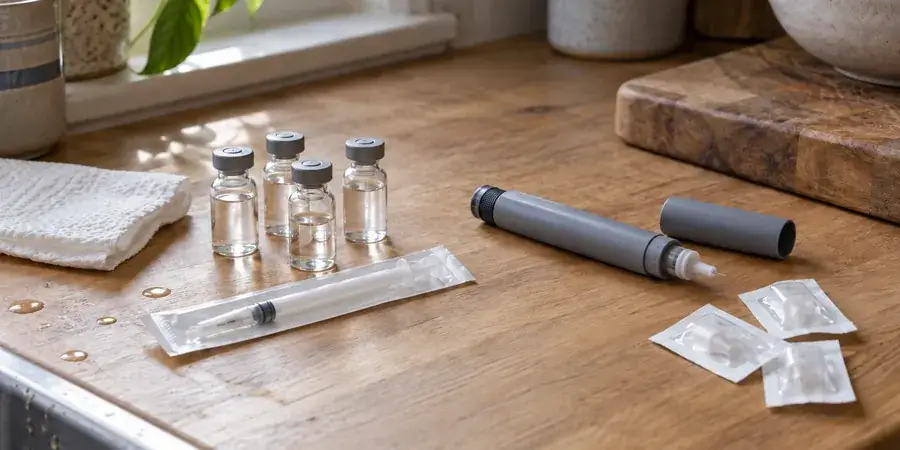
Zepbound forms compared, prices and terms as of October 15, 2026.
How to choose between vial and KwikPen
- Vial: you draw each dose with a syringe, which takes some practice and a steady hand. The vial offer lists no annual fill limit.
- KwikPen: you dial the dose and attach a pen needle, so injections are faster. The FDA approved it in late January 2026, and LillyDirect began selling it on February 23, 2026.
- Single-dose pen: nothing to measure or attach, though it is the form tied to insurance and to the $499 not-covered price.
Needles, syringes and pen needles are extra. LillyDirect sells them at checkout for a small fee, and any local pharmacy carries them too. The Zepbound vial price and the KwikPen price are identical, so supplies and handling are the only cost difference between the two. Home delivery is free, and both the vial and the KwikPen can be picked up at Walmart Pharmacy.
The 45-day refill rule and what a late refill costs
The $449 price for 7.5 to 15 mg belongs to Lilly’s Self Pay Journey Program. Your next fill must arrive within 45 days of the previous delivery. Miss that window, and regular prices apply: $499 for 7.5 mg and $699 for 10, 12.5 or 15 mg.
A 28-day fill leaves a buffer of 17 days. A short trip or a few days of delay at the pharmacy stays inside it. A treatment pause of two months does not, and the first fill after it costs more.
- Late refill at 7.5 mg: $50 more than the program price.
- Late refill at 10 to 15 mg: $250 more than the program price.
- Late refill at 2.5 or 5 mg: no change, since the rule does not apply to these doses.
Three refill scenarios
- You refill on day 28 every time: you pay $449 at 10 mg all year.
- A shipping delay pushes one refill to day 40: still inside the window, still $449.
- You pause for six weeks after a stomach bug and restart on day 70: that fill costs $699 at 10 mg, and the program price returns from the next on-time refill.
A pause can also affect dosing. The prescribing information says a dose missed by more than four days should be skipped. Longer breaks are a question for the prescriber, who may restart you at a lower dose. A lower restart dose can cost less per fill, so ask about both the dose and the price before reordering.
Lilly has changed the regular prices before. Its December 1, 2025 announcement listed regular vial prices of $599 for 7.5 mg, $849 for 12.5 mg and $1,049 for 15 mg. The October 2026 LillyDirect page lists $499 and $699 instead, so check the current figure before a planned pause.
The KwikPen card covers 11 fills, while a year needs 13
The KwikPen self-pay savings card can be used for up to 11 prescription fills per calendar year, according to LillyDirect’s full terms. Weekly dosing with 28-day pens takes 13 fills in 365 days. The terms do not say what price applies to fills 12 and 13.
The card also expires on December 31, 2026. A patient who starts in January and stays on the KwikPen all year could reach the 11-fill limit in late October. The separate Journey Program offer for vials and KwikPens at 7.5 to 15 mg lists no fill limit, which may cover the gap.
When the limit arrives in a calendar year
Take a patient whose first KwikPen fill lands on January 1, 2026, with refills every 28 days. The fill dates fall this way.
- Fill 1: January 1.
- Fill 11, the last one the card covers: October 8.
- Fill 12: November 5.
- Fill 13: December 3.
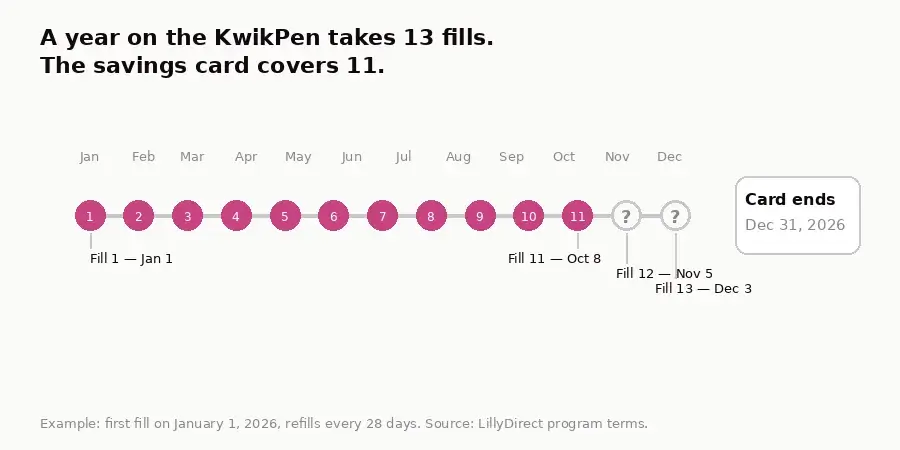
If fills 12 and 13 at 10 to 15 mg were billed at the $699 regular price, the year would cost $500 more. The terms neither confirm nor rule out that outcome, which is why the phone check below is worth making.
What to do about it
- Before your 11th KwikPen fill of the year, call LillyDirect Customer Care at 1-844-559-3471 and ask the price of fills 12 and 13.
- Ask whether switching to vials for those fills keeps the $449 price.
- Check again in December, when Lilly is expected to publish 2027 terms for the card.
This limit is easy to miss, because most price guides quote the monthly figure and stop there. It matters most for people on 10 or 15 mg, where the gap between the program price and the regular price is largest.
What a year of Zepbound costs without insurance
The yearly total depends on the maintenance dose and on fill count. Some calculators multiply the monthly price by 12 and land about one fill short, because Zepbound fills last 28 days. The table counts 13 fills, assumes standard four-week dose steps and no late refills.
| Dose path | Calculation (13 fills) | Year-one total | Average per 30 days |
|---|---|---|---|
| 2.5 mg, then 5 mg maintenance | $299 + 12 x $399 | $5,087 | about $418 |
| 2.5 mg, 5 mg, then 7.5 mg or higher | $299 + $399 + 11 x $449 | $5,637 | about $463 |
| Second year at 7.5 mg or higher | 13 x $449 | $5,837 | about $480 |
An independent tracker estimated $4,688 and $5,188 for the same two paths in June 2026. Both sets of figures are correct for their method. The tracker counted 12 fills, and this table counts 13, so each of its totals is one fill lower.
Zepbound yearly cost estimator
13 fills of 28 days, standard dose steps, prices checked October 15, 2026.
Excludes needles, syringes and visit fees.
Daily and weekly cost at maintenance
At $449 per 28 days, Zepbound costs about $16.04 a day, or $112.25 per weekly injection. At 5 mg the figures fall to about $14.25 a day and $99.75 per injection. These numbers help when comparing a cash price with a telehealth bundle quoted per month or per week.
Costs outside the drug price
- Needles or syringes for 52 injections a year, added at checkout or bought locally.
- Prescriber visits, whether in person or by telehealth, which LillyDirect does not include.
- Late-refill surcharges, as covered above.
Cost per pound lost: what the SURMOUNT-1 averages imply
Price per fill says little about value, so this section ties cost to the average results Lilly reports for SURMOUNT-1. That trial ran 72 weeks in adults with obesity and no diabetes. Average loss was 15.0% at 5 mg, 19.5% at 10 mg and 20.9% at 15 mg, against 3.1% on placebo.
The example below takes a 220-pound adult and 18 fills, which covers 72 weeks. Dose steps follow the label, and prices are the October 2026 self-pay figures.
| Maintenance dose | Average loss | Pounds lost (220 lb start) | Cost of 18 fills | Cost per pound lost |
|---|---|---|---|---|
| 5 mg | 15.0% | 33.0 lb | $299 + 17 x $399 = $7,082 | about $215 |
| 10 mg | 19.5% | 42.9 lb | $299 + $399 + 16 x $449 = $7,882 | about $184 |
| 15 mg | 20.9% | 46.0 lb | $299 + $399 + 16 x $449 = $7,882 | about $171 |
For a 180-pound adult, the same averages give 27.0, 35.1 and 37.6 pounds. The cost per pound then rises to about $262 at 5 mg, $225 at 10 mg and $210 at 15 mg. The drug cost stays fixed while the pounds lost shrink.
Because doses from 7.5 to 15 mg share one price, the cost per pound falls at higher doses. These are trial averages, and individual results vary widely in both directions. The figures describe the price structure and do not suggest a dose, which depends on tolerance and on your prescriber’s judgment.
Zepbound price with and without insurance, side by side
The Zepbound price you pay depends on your coverage more than on the pharmacy. The list price, about $1,086.37 for a 28-day supply of single-dose pens per an independent tracker in September 2026, is the reference point. Few patients pay it, since insurers, savings cards and cash programs all start from it.
| Your situation | Form | What you pay | Key condition |
|---|---|---|---|
| No insurance, self-pay | Vial or KwikPen | $299 to $449 | Refill within 45 days for 7.5 mg and up |
| Commercial plan that covers Zepbound | Single-dose pen | As little as $25 | Savings card, up to $100 off per month and $1,300 per year |
| Commercial plan that does not cover it | Single-dose pen | As low as $499 | Savings card, up to 13 fills per year |
| Commercial plan that does not cover it | KwikPen | $299 to $449 | Savings card, up to 11 fills per year |
| Medicare Part D, meets Bridge criteria | KwikPen only | $50 | July 1, 2026 to December 31, 2027 |
| Medicare or Medicaid, no Bridge eligibility | Any | Self-pay price | Savings cards exclude government coverage |
How far below list price the cash price sits
Measured against the $1,086.37 list price, the self-pay ladder is about 72% off at 2.5 mg. The discount is 63% at 5 mg and 59% at 7.5 mg and above. A discount card quote for the single-dose pen can look like a bargain against list. It may still cost more than the LillyDirect vial or KwikPen at the same dose.
Why the not-covered single-dose pen costs more
If your commercial plan excludes Zepbound, the savings card brings the single-dose pen to $499. The KwikPen at maintenance costs $449, or $50 less per fill, which adds up to $650 over 13 fills. At 5 mg the gap is $100 per fill. Asking your prescriber to write the KwikPen instead is often the simplest saving available.
The $25 copay applies only when your plan covers Zepbound. The card then pays up to $100 of each monthly fill. If your plan’s copay is above $125, you pay the remainder.
Check insurance coverage before you pay cash
Commercial coverage for weight loss drugs is limited. Coverage is far more common at the largest employers. KFF found that more than four in ten firms with 5,000 or more workers covered GLP-1s for weight loss in 2025. If you work for a company that size, a coverage check takes ten minutes. It can bring each 28-day fill from $449 to $25, a difference of about $5,500 over 13 fills.

How to check coverage for Zepbound
- Search your plan’s drug formulary for Zepbound and note any prior authorization or step therapy flag.
- Even when Zepbound appears on the formulary, confirm with HR that the plan has no exclusion for weight-loss use.
- If you have moderate-to-severe obstructive sleep apnea, ask whether the plan covers Zepbound for that indication.
- If the plan covers it, activate the Zepbound savings card before the first fill.
If your plan says no
A denial is not always final. Plans that approve Zepbound typically want the prescriber’s notes on BMI, related conditions such as high blood pressure, and earlier attempts to lose weight. Missing paperwork is a common reason for refusal, and the plan’s appeal process allows a second review. While an appeal runs, the self-pay price stays available, and you can switch back to the savings card if coverage is approved.
The sleep apnea route matters for Medicare too. The FDA approved Zepbound for moderate-to-severe obstructive sleep apnea in adults with obesity in late December 2024. CMS confirmed on January 8, 2025, that Medicare plans can cover it for that use. Coverage still depends on the individual plan and its prior authorization rules.
How to order Zepbound through LillyDirect, step by step
LillyDirect is Lilly’s own pharmacy and ordering platform. It fills only valid prescriptions, so the clinical step comes first. The order follows these steps.
- Get a prescription from a licensed clinician, in person or by telehealth, for the vial or the KwikPen at your current dose.
- Ask the prescriber to send it to LillyDirect Pharmacy, by e-prescribing, by phone at 1-855-723-4672 or by fax, with your mobile number and email.
- Create your LillyDirect account and confirm your details with the pharmacy when it contacts you.
- Choose self-pay, add needles or syringes, and pick free home delivery or Walmart Pharmacy pickup.
- Pay by card, including HSA or FSA cards. Most orders ship within one to four days.
- Set a reminder for your next refill well before day 45.
Walmart pickup is offered at more than 4,600 locations for eligible medicines, which suits people who are away during delivery hours. Cash is accepted only for in-person pickup. Home delivery orders need a card.
Moving from another pharmacy needs a new prescription sent to LillyDirect, and you do not have to cancel at the old pharmacy. Choosing self-pay also means no prior authorization. If you have insurance and still pay cash, you agree not to seek reimbursement from your plan.
Questions to settle before the first order
- Is the prescription for the vial or the KwikPen? The form must match what you order.
- Who handles dose increases every four weeks, and how fast can the prescriber send a new strength?
- Does your telehealth service charge a monthly fee on top of the LillyDirect price?
TrumpRx and Zepbound: the same LillyDirect price
TrumpRx launched on February 5, 2026, as a government site that gathers manufacturer cash offers in one place. It lists Zepbound and does not sell it. The listing sends you to LillyDirect, where the price ladder is the same $299, $399 and $449.
What the TrumpRx listing does and does not add
- It shows the self-pay price next to the original list price of about $1,087, which makes the discount visible.
- It does not issue prescriptions, check eligibility or apply insurance.
- It does not change the KwikPen card limit of 11 fills per year or its December 31, 2026 end date.
For Zepbound buyers the practical test is simple. If your plan covers the drug, the $25 savings card beats the TrumpRx-listed price by $274 to $424 per fill. The portal therefore helps only people who would pay cash anyway. Pharmacy policy analysts reached the same view of the portal in early 2026.
Using TrumpRx therefore changes nothing about price, form or the 45-day rule. It is one more entry point to the same order page. Whichever door you use, the purchase is cash, and the amount will not reduce your plan’s deductible or out-of-pocket maximum.
Fake pharmacy sites that imitate manufacturer pages are a known risk with GLP-1 drugs. Type the LillyDirect address yourself rather than following ads, and be wary of any offer far below $299 for brand-name Zepbound.
Medicare and Zepbound: $50 a month through the Bridge, KwikPen only
Medicare Part D still cannot cover Zepbound for weight loss alone. It can cover Zepbound for moderate-to-severe obstructive sleep apnea in adults with obesity. The Medicare GLP-1 Bridge runs from July 1, 2026, to December 31, 2027. It charges $50 for a one-month supply to Part D enrollees who meet its criteria.
Bridge rules that affect Zepbound
- Only the Zepbound KwikPen is covered. Vials and single-dose pens are excluded.
- Eligibility needs Part D coverage, age 18 or older and a qualifying BMI: 35 or higher, 30 or higher with certain heart, blood pressure or kidney conditions, or 27 or higher with prediabetes or past heart attack, stroke or blocked arteries.
- People with type 2 diabetes, moderate-to-severe sleep apnea or fatty liver disease are excluded, because Part D can already pay for Zepbound in some of those cases, sleep apnea above all.
- The $50 copays sit outside Part D, so they never reduce your deductible or the plan’s yearly cap.
How to get the Bridge price
- Make sure the prescription names the Zepbound KwikPen. A vial or single-dose pen prescription will not qualify.
- The pharmacy runs the claim through the Bridge processor, and your doctor files the approval form Medicare asks for.
- Once Medicare’s approval letter arrives, each 28-day KwikPen costs $50.
- Dose increases from 2.5 mg up to 15 mg stay on the same approval, since the drug does not change.
A KwikPen month is 28 days, so a full year costs 13 x $50, or $650. Medicare enrollees cannot use Lilly’s savings cards. Those who fail the Bridge criteria can still self-pay through LillyDirect at the standard prices.
How the Zepbound price changed from 2025 to 2026
The current price ladder is recent. Most guides written before December 2025 quote higher vial prices, so their totals overstate the cost today. The main changes are listed below.
| Date | Change |
|---|---|
| Before December 1, 2025 | Vials at $349 (2.5 mg) and $499 (5 mg and higher) |
| December 1, 2025 | Vials cut to $299, $399 and $449, with the 45-day rule for 7.5 mg and up |
| Late January 2026 | FDA approves the multi-dose Zepbound KwikPen |
| February 5, 2026 | TrumpRx launches and lists Zepbound through LillyDirect |
| February 23, 2026 | KwikPen goes on sale through LillyDirect at the vial prices |
| July 1, 2026 | Medicare GLP-1 Bridge starts at $50 for the KwikPen |
| December 31, 2026 | KwikPen savings card and commercial savings card terms end |
Each change above moved the cash price down or widened access at the same price. None of them raised the self-pay ladder. The one scheduled change ahead is the end of the 2026 card terms. That decision will set KwikPen pricing for 2027 and the treatment of fills beyond the yearly cap.
The direction since late 2025 has been lower cash prices and more forms at the same price. The open question for 2027 is whether Lilly renews the KwikPen card on the same terms and keeps the regular prices for late refills at $499 and $699.
Lilly states that it can change or end these offers at any time. The next scheduled review of this page falls in January 2027, after new card terms are expected.
When LillyDirect self-pay is not the cheapest route
Self-pay through LillyDirect is the standard choice without coverage, though three situations change the math.
- Your commercial plan covers Zepbound: the savings card at $25 beats any cash price by far, so check coverage and prior authorization first.
- You qualify for the Medicare Bridge: $50 for the KwikPen is the lowest price available to anyone.
- Your plan covers Zepbound for sleep apnea: if you have that diagnosis, ask whether the plan covers it under that indication.
Mounjaro is not a cheaper shortcut
Mounjaro contains the same tirzepatide and is approved for type 2 diabetes. An independent tracker recorded a $499 TrumpRx price for Mounjaro in September 2026, above every Zepbound self-pay dose. Using it for weight loss alone would also be off-label, a decision that stays with the prescriber and that insurers rarely cover.
Coupons, compounded tirzepatide and other offers
Pharmacy coupon prices for single-dose pens usually sit far above the LillyDirect cash price, since the pen form is priced for insurance. Compounded tirzepatide is sold more cheaply by some clinics. It is not FDA-approved, and the FDA ended the shortage-era allowance for mass compounding in early 2025. Brand-name Zepbound at $299 to $449 removes most of the price argument for those products.
A price check before every order
- Confirm the dose and form on the prescription match the LillyDirect listing.
- Check that the next refill falls inside 45 days of the last delivery.
- Count your KwikPen fills for the calendar year if you use the savings card.
- Add needles or syringes once, for the whole month.
HSA and FSA cards are accepted at LillyDirect, which lowers the effective cost for people with pre-tax accounts. Telehealth services that prescribe Zepbound often add a monthly membership on top of the drug price. Compare the total, drug plus service, before choosing.
About this guide: sources and affiliate disclosure
This guide is written for adults in the US comparing Zepbound prices and does not replace medical or insurance advice. Facts were checked against LillyDirect price pages and full program terms, Lilly’s coverage and savings page, the Zepbound prescribing information, the CMS Medicare GLP-1 Bridge fact sheet and Lilly’s December 2025 price announcement. Our primary sources were lilly.com/lillydirect/medicines/zepbound, zepbound.lilly.com and www.medicare.gov. Prices and program terms change every one to three months, so each figure carries its check date.
- Last reviewed: October 15, 2026. Next scheduled review: January 2027, or sooner when Lilly changes prices or card terms.
- Affiliate disclosure: some buttons on this site lead to telehealth partners that may pay us a commission when you start a visit. Partner payments do not change the prices or program rules reported here. Links to manufacturer and government programs are not monetized.