
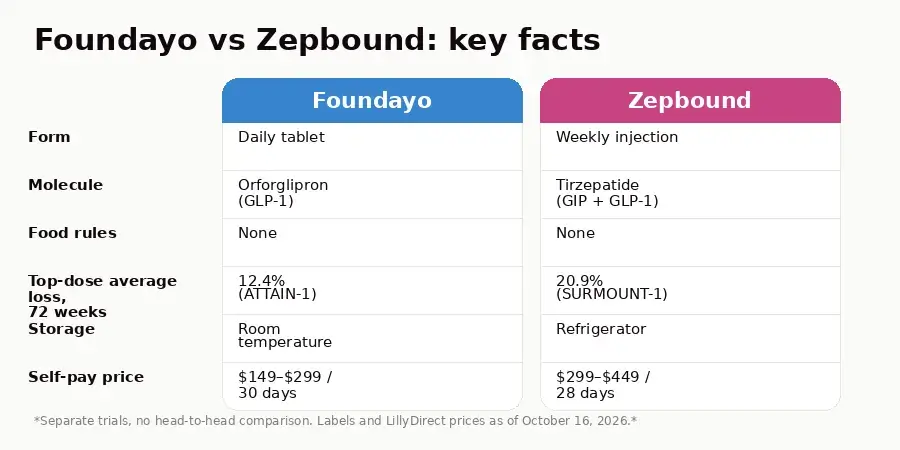
Foundayo vs Zepbound is a choice between two different Eli Lilly drugs, a daily pill and a weekly injection. Foundayo contains orforglipron, a small-molecule GLP-1 drug, and Zepbound contains tirzepatide, which acts on both the GIP and GLP-1 receptors. No trial has compared them head to head. In their separate pivotal trials, average loss after 72 weeks was 12.4% at the top Foundayo dose and 20.9% at the top Zepbound dose. Self-pay prices run $149 to $299 a month for Foundayo and $299 to $449 per 28 days for Zepbound, as of October 16, 2026.
Which one fits better depends on health history, how you feel about injections, other medicines you take, coverage and budget. Those are questions for you and your prescriber, and this page sets out the facts for that conversation. For the wider picture of GLP-1 drugs, see our GLP-1 weight loss guide.

In this guide
Foundayo vs Zepbound at a glance
The two drugs share a maker, a target receptor and a boxed warning. Almost everything else differs, from the molecule to the storage rules.
Separate trials, no head-to-head comparison. Labels and prices as of October 16, 2026; both drugs covered by the Medicare GLP-1 Bridge at $50 (Zepbound KwikPen only).
Both are sold by Eli Lilly through the same channels, including its LillyDirect pharmacy, so availability is rarely the deciding factor. FDA approval came years apart. Zepbound was approved for weight management in 2023 and for sleep apnea in December 2024. Foundayo was approved on April 1, 2026, and reached pharmacies on April 9.
Is Foundayo tirzepatide? No, it is a different molecule
Foundayo does not contain tirzepatide, and it is not a pill version of Zepbound. Orforglipron is a separate molecule that Lilly developed as a small, non-peptide drug. Searches for “Foundayo vs tirzepatide” or “orforglipron vs tirzepatide” compare two distinct medicines.
The naming confusion has a source. Both drugs come from Lilly, both appear in the same weight-loss searches, and Foundayo arrived as the company’s first GLP-1 pill. Comparing orforglipron vs Zepbound is therefore a comparison of two molecules as well as two forms.
How the two molecules work
- Orforglipron activates the GLP-1 receptor only. It mimics the gut hormone that signals fullness and slows stomach emptying.
- Tirzepatide activates the GLP-1 receptor and the GIP receptor, a second gut-hormone target. That dual action is why it is called a dual agonist.
- Orforglipron is small enough to survive digestion, so it works as a tablet without fasting rules.
- Tirzepatide is built from amino acids, much like a natural gut hormone, and digestion would destroy it, which is why it goes under the skin.
No oral version of tirzepatide is approved in the US. Anything marketed online as “oral tirzepatide” is a compounded product without FDA approval. For a pill option from Lilly, Foundayo is the approved choice, and for tirzepatide, Zepbound or Mounjaro injections are the approved forms.
Weight loss results: two separate trial programs
Is Foundayo as effective as Zepbound? The pivotal trials suggest Zepbound produced larger average loss, though the trials were separate and enrolled different people. Read the numbers below as each drug’s own result against placebo.
| Drug and dose | Trial | Average loss on drug | Placebo | Method |
|---|---|---|---|---|
| Foundayo 5.5 mg | ATTAIN-1 | 7.8% | figure absent from the summary used here | Efficacy estimand |
| Foundayo 9 mg | ATTAIN-1 | 9.3% | figure absent from the summary used here | Efficacy estimand |
| Foundayo 17.2 mg | ATTAIN-1 | 12.4% (11.1% counting all participants) | 0.9% (2.1% counting all participants) | Both methods reported |
| Zepbound 5 mg | SURMOUNT-1 | 15.0% | 3.1% | All randomized patients |
| Zepbound 10 mg | SURMOUNT-1 | 19.5% | 3.1% | All randomized patients |
| Zepbound 15 mg | SURMOUNT-1 | 20.9% | 3.1% | All randomized patients |
ATTAIN-1 enrolled 3,127 adults. In adults with type 2 diabetes, a separate population, Foundayo 17.2 mg produced about 9.6% average loss against 2.5% on placebo. Zepbound has its own diabetes-population data, which this page does not compare.
Why the numbers are not a direct ranking
- Different methods: the 12.4% Foundayo figure assumes people took the drug as directed, while the SURMOUNT-1 figures count all randomized patients. The like-for-like Foundayo number is closer to 11.1%.
- Different people: each trial enrolled its own population, with its own starting weights and health profiles.
- Different dose paths: each drug was escalated on its own schedule to its own top dose.
- No direct comparison: only a head-to-head trial can show how the two drugs perform in the same people, and none has reported.
How many people reached larger losses
- Zepbound, SURMOUNT-1: 85% to 91% of patients lost at least 5% of body weight, and 30% to 57% lost at least 20%, depending on dose.
- Foundayo, ATTAIN-1: at 17.2 mg, roughly one in two participants lost at least 10% of body weight, as reported in summaries of the trial.
The thresholds differ between the two reports, which limits the comparison. They do show that on either drug some people lose far more than the average and some far less.
With those limits in mind, both drugs produced meaningful average loss against placebo, and the tirzepatide figures were higher. Individual results vary widely on either drug. A prescriber can weigh those averages against your own goals, history and tolerance.
Switching from Zepbound to Foundayo: what ATTAIN-MAINTAIN found
ATTAIN-MAINTAIN is the only Lilly trial so far that put people on Foundayo after an injection. It enrolled 376 adults who had reached a weight plateau after 72 weeks on Zepbound or Wegovy in the SURMOUNT-5 trial. They were randomized to orforglipron or placebo for 52 weeks, with topline results announced on December 18, 2025.
| Group | Start of SURMOUNT-5 | Switch to orforglipron | After 52 weeks on orforglipron |
|---|---|---|---|
| Came from Zepbound | 115.8 kg (255.3 lb) | 90.9 kg (200.4 lb) | 95.9 kg (211.4 lb) |
| Came from Wegovy | 113.5 kg (250.2 lb) | 95.0 kg (209.4 lb) | 95.9 kg (211.4 lb) |

What the weights imply
The Zepbound group had lost 24.9 kg on the injection and regained 5.0 kg after switching, about 20% of the weight lost. The Wegovy group had lost 18.5 kg and regained 0.9 kg, about 5%. Those percentages are our own calculation from Lilly’s published weights. In the 24-week post hoc analysis, placebo groups regained about 9 kg, so orforglipron kept most of the loss in both groups.
The cost side of a switch
Moving from Zepbound at $449 per 28 days to Foundayo at $299 per 30 days saves about $182 a month, or roughly $2,185 a year at maintenance prices. ATTAIN-MAINTAIN puts a clinical figure next to that saving: an average regain of about 5 kg over a year in the group that came from Zepbound. Whether that trade-off makes sense is a personal and clinical decision, and the trial gives the prescriber a number to work with.
The trial met its primary endpoint against placebo. It also suggests that people who leave Zepbound for Foundayo may keep less of their loss than people coming from Wegovy. The full results were due for publication in 2026, and any switch should be planned with a prescriber, who picks the new starting dose.
Dosing and daily routine compared
The practical difference most people notice first in a Foundayo pill vs Zepbound comparison is the schedule. Foundayo is one tablet a day, and Zepbound is one injection a week. Both start low and rise in steps.
Foundayo dose steps
- Start at 0.8 mg once daily.
- Each later step, 2.5, 5.5, 9, 14.5 and 17.2 mg, needs a minimum of 30 days on the previous dose.
- Your prescriber decides whether to climb further, depending on how well you respond and tolerate it.
- Swallow the tablet whole, with or without food. No more than one tablet a day.
Zepbound dose steps
- Start at 2.5 mg once weekly for 4 weeks. That dose is for starting only.
- Move to 5 mg, then increase in 2.5 mg steps with at least 4 weeks on each dose.
- Maintenance doses are 5, 10 or 15 mg for weight management, and 10 or 15 mg for sleep apnea.
- Inject under the skin of the abdomen, thigh or upper arm on the same day each week.
Going the other way, from Foundayo to Zepbound
No published trial has tested a switch from Foundayo to Zepbound. A prescriber who makes that change typically starts Zepbound on its own dose schedule rather than converting milligrams, since the molecules differ. That restart puts you back on the $299 starting fill, then $399, before reaching maintenance pricing.
Missed doses and the half-life
The half-life shapes what a missed dose means. Zepbound stays in the body for about five days, so the label allows a missed dose to be taken within 4 days, and skipped after that. Foundayo clears faster, at roughly 29 to 49 hours. A missed tablet is taken as soon as possible without doubling up, and missing 7 or more days in a row means restarting at a lower dose.
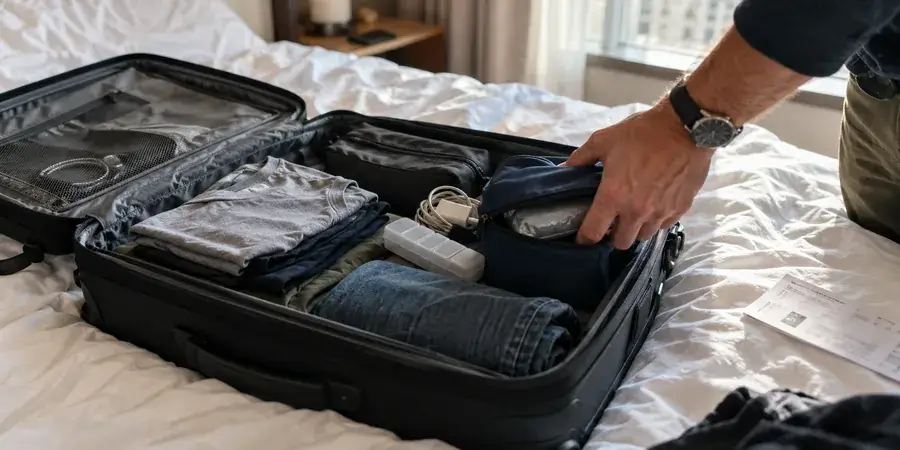
Storage follows the molecule. Foundayo tablets are kept at room temperature, which suits travel. Zepbound pens and vials are stored in the refrigerator, with limited time allowed outside it, which takes planning on longer trips.
Side effects compared, from each drug’s label
Both drugs cause mainly digestive side effects, most often at the start and after dose increases. The figures below come from each label’s own trials, so they show each drug against its placebo group.
| Side effect | Foundayo 17.2 mg | Foundayo placebo | Zepbound 15 mg | Zepbound placebo |
|---|---|---|---|---|
| Nausea | 35% | 10% | 28% | 8% |
| Diarrhea | 25% | 11% | 23% | 8% |
| Vomiting | 24% | 4% | 13% | 2% |
| Constipation | 24% | 9% | 11% | 5% |
| Abdominal pain | 14% | 7% | 10% | 5% |
| Stopped due to side effects | 10% | 3% (all doses pooled) | 6.7% | 3.4% |
In these label tables, vomiting and constipation were more common with Foundayo at its top dose, and discontinuation was somewhat higher. Zepbound adds injection-site reactions, reported in 8% of patients at 15 mg against 2% on placebo. Because the trials differ, the gaps are a guide to discuss and not a measured difference between the drugs.
Nausea by dose step
- Foundayo: 26% at 5.5 mg, 34% at 9 mg and 35% at 17.2 mg, against 10% on placebo.
- Zepbound: 25% at 5 mg, 29% at 10 mg and 28% at 15 mg, against 8% on placebo.
On both labels, nausea climbs over the first steps and then levels off. Discontinuation follows a similar pattern, rising from 6% at 5.5 mg to 10% at 17.2 mg for Foundayo and from 4.8% at 5 mg to 6.7% at 15 mg for Zepbound.
Tolerance usually sets the dose
Side effects on both drugs tend to rise with dose. Many patients settle at a step below the maximum because the next one is harder to tolerate. Slower escalation, smaller meals and fluids help, and your prescriber can hold a dose longer when needed.
Safety, interactions and who should avoid each drug
The two labels share their core warnings. Both carry a boxed warning about thyroid C-cell tumors seen in rodent studies, whose relevance to humans is unknown.

- Neither drug should be used with a personal or family history of medullary thyroid carcinoma or MEN 2.
- Both list warnings for pancreatitis, gallbladder disease, low blood sugar alongside other diabetes drugs and procedures under sedation.
- Both should be stopped in pregnancy, and both affect oral contraceptives.
Where the safety profiles differ
- Oral contraceptives: Foundayo users add a barrier method for 30 days after starting and after each dose increase. Zepbound sets 4 weeks after starting and after each increase.
- Drug interactions: Foundayo is processed by the liver enzyme CYP3A4. Strong CYP3A4 inhibitors cap the Foundayo dose at 9 mg, and strong inducers should be avoided.
- Statins: with Foundayo, simvastatin should not exceed 20 mg a day. Atorvastatin and rosuvastatin levels also rise, by about 1.5 and 1.7 times.
- Liver monitoring: as part of Foundayo’s approval, Lilly agreed with the FDA to five years of liver safety monitoring. Lilly reports no liver safety signal in the phase 3 program to date.
Shared precautions in daily life
- Dehydration: vomiting or diarrhea can strain the kidneys on either drug, so fluids matter during dose increases.
- Procedures: both labels flag a risk of inhaling stomach contents under anesthesia, so surgeons and anesthesiologists need to know you take either drug.
- Diabetes medicines: both raise the risk of low blood sugar when combined with insulin or sulfonylureas, which may need dose changes.
The interaction list matters for people on several medicines. A pharmacist can check your list against both labels before you choose.
Cost compared: Foundayo vs Zepbound without insurance
Foundayo is the lower-cost option at every stage on cash prices. Lilly sells both through LillyDirect, and the prices below were checked on October 16, 2026.
| Stage | Foundayo (30 tablets) | Zepbound (28-day fill) |
|---|---|---|
| Starting dose | $149 (0.8 mg) | $299 (2.5 mg) |
| Second step | $149 (2.5 mg, reduced through Dec 31, 2026) | $399 (5 mg) |
| Third step | $199 (5.5 mg, reduced through Dec 31, 2026) | $449 (7.5 mg) |
| Maintenance | $299 (9 to 17.2 mg) | $399 (5 mg) or $449 (7.5 to 15 mg) |
| Refill condition | 14.5 and 17.2 mg within 45 days for $299 | 7.5 to 15 mg within 45 days for $449 |
The first six months, month by month
| Fill | Foundayo dose and price | Zepbound dose and price |
|---|---|---|
| 1 | 0.8 mg, $149 | 2.5 mg, $299 |
| 2 | 2.5 mg, $149 | 5 mg, $399 |
| 3 | 5.5 mg, $199 | 7.5 mg, $449 |
| 4 | 9 mg, $299 | 10 mg, $449 |
| 5 | 14.5 mg, $299 | 12.5 mg, $449 |
| 6 | 17.2 mg, $299 | 15 mg, $449 |
| Total | $1,394 for 180 days | $2,494 for 168 days |
The dose paths above climb to each drug’s maximum for illustration. Many patients stop at a lower maintenance dose. Staying at 5 mg lowers Zepbound’s total, while Foundayo’s price stays the same from 9 mg up.
The gap in dollars
- First four fills: $796 for Foundayo against $1,596 for Zepbound.
- Maintenance: Zepbound at $449 per 28 days equals about $481 per 30 days, so Foundayo at $299 costs about $182 less each month.
- First year, standard dose path: about $3,188 for Foundayo and $5,637 for Zepbound, a gap of about $2,449.
Neither price includes visit fees. Zepbound also needs needles or syringes for the KwikPen and vial, while Foundayo needs no supplies. Detailed price rules are on our pages for Zepbound cost without insurance and for Foundayo pricing by dose.
Where each drug is sold
- LillyDirect sells both drugs at the prices above, with free home delivery.
- Amazon Pharmacy carries Foundayo at $149 cash for the starting dose, with same-day delivery in many cities.
- Walmart Pharmacy offers pickup for Zepbound vials and KwikPens ordered through LillyDirect.
- TrumpRx lists both drugs and sends buyers to LillyDirect at the same prices.
Insurance and Medicare: coverage routes differ
Commercial plans decide coverage drug by drug, and both drugs have a Lilly savings card for covered patients. With a plan that covers the drug, each card can bring a fill to as little as $25. Both cards exclude Medicare, Medicaid and other government coverage.
Savings card terms side by side
| Term | Foundayo | Zepbound |
|---|---|---|
| Plan covers the drug | As little as $25, up to $100 off per month, $1,000 per year, 10 fills | Single-dose pen as little as $25, up to $100 off per month, $1,300 per year, 13 fills |
| Plan does not cover it | $149 to $299 by dose, 10 fills | Single-dose pen as low as $499, or KwikPen $299 to $449, 11 fills |
| Card end date | December 31, 2026 | December 31, 2026 |
Why Zepbound has an extra coverage route
Zepbound is approved for moderate-to-severe obstructive sleep apnea in adults with obesity. CMS confirmed in January 2025 that Medicare plans can cover it for that use, and commercial plans may do the same. Foundayo’s single indication, as of October 2026, is chronic weight management. A plan that excludes weight-loss drugs therefore has no other indication to cover Foundayo under.
The Medicare GLP-1 Bridge
- Both drugs are covered at $50 a month for eligible Part D enrollees, from July 1, 2026, to December 31, 2027.
- For Zepbound, only the KwikPen qualifies. Vials and single-dose pens do not.
- People with type 2 diabetes, moderate-to-severe sleep apnea or fatty liver disease are excluded, since Part D may already cover a GLP-1 for them.
Factors to discuss with your prescriber
Neither drug suits everyone, and the choice is a clinical one. Framing the question as Zepbound vs Foundayo, or the reverse, matters less than matching the drug to your situation. The points below are common reasons people and their prescribers lean one way or the other. They do not predict how either drug will work for you.
Pill or injection? Points to raise with your prescriber
Tick what applies to you. This tool lists discussion points only and does not recommend a drug.
Bring your ticked points and your medication list to the appointment.
Points that may favor Foundayo
- A strong wish to avoid injections.
- Frequent travel, where room-temperature tablets are easier than refrigerated pens.
- A tighter budget, since the cash price is lower at every step.
- A treatment goal that the Foundayo trial averages already meet, as judged with your prescriber.
Points that may favor Zepbound
- A larger weight-loss goal, given the higher trial averages for tirzepatide.
- Moderate-to-severe obstructive sleep apnea, which Zepbound is approved to treat.
- Medicines that interact with Foundayo through CYP3A4, or high-dose simvastatin.
- A preference for one dose a week over a daily tablet.
Questions to bring to the appointment
- Given my health history, are both drugs options for me?
- Do any of my current medicines interact with Foundayo?
- Which drug does my plan cover, and is a prior authorization needed?
- If I start one and it does not suit me, how would a switch work?
- Which side effects should prompt a call to your office?
What is still unknown about Foundayo vs Zepbound
Several open questions matter for this comparison, and they are worth knowing before choosing. The points below were unresolved as of October 16, 2026.
- A head-to-head trial: no study has compared orforglipron and tirzepatide directly in the same population.
- Full ATTAIN-MAINTAIN data: Lilly announced topline results in December 2025, with full publication expected in 2026.
- Long-term Foundayo use: the pivotal data run to 72 weeks, while tirzepatide has a longer track record in diabetes and weight management.
- Liver monitoring: the five-year postmarketing program for Foundayo is still running.
- New indications: Foundayo is approved only for weight management, and any future diabetes approval would change its coverage picture.
Prices are the other moving part. Both Lilly savings cards end on December 31, 2026, and the temporary Foundayo reductions at 2.5 and 5.5 mg expire the same day. A 2027 price change at either drug could narrow or widen the cost gap shown above.
These gaps do not make either drug a poor choice. They mean the comparison will change as new data arrive, and this page will be updated when they do.
About this comparison: sources and affiliate disclosure
This comparison is written for adults in the US and does not replace medical advice. Facts were checked against the Foundayo and Zepbound prescribing information, Lilly’s ATTAIN-1, SURMOUNT-1 and ATTAIN-MAINTAIN data, Lilly’s medical information service, LillyDirect price pages and the CMS Medicare GLP-1 Bridge fact sheet. Our primary sources were uspl.lilly.com, lilly.com/lillydirect and www.medicare.gov. Prices and program terms change every one to three months, so each figure carries its check date.
- Last reviewed: October 16, 2026. Next scheduled review: January 2027, or sooner when new trial data or prices appear.
- Affiliate disclosure: some buttons on this site lead to telehealth partners that may pay us a commission when you start a visit. Partner payments do not change the trial data, prices or label facts reported here.