
GLP-1 weight loss in the US runs on five FDA-approved brand drugs: Wegovy injection, Wegovy HD, Wegovy pill, Zepbound and Foundayo. Without insurance, manufacturer self-pay prices run from $149 a month for starter pill doses to $449 for Zepbound maintenance doses, as of October 15, 2026. First-year self-pay costs run from about $3,200 to $5,600, depending on the drug. Every option needs a prescription from a licensed clinician, and online prescriptions through telehealth follow the same medical rules as office visits. Eligible Medicare enrollees can pay $50 a month through the Medicare GLP-1 Bridge until December 31, 2027.

Start with the question that decides your cheapest route.
- Commercial insurance that lists the drug on its formulary: a manufacturer savings card can bring the copay to as little as $25 a month.
- Medicare Part D without type 2 diabetes, moderate-to-severe sleep apnea or fatty liver disease: check the Bridge criteria below.
- Neither: self-pay through LillyDirect or NovoCare is the standard route, often with a telehealth prescriber.
Buying a GLP-1 without insurance usually means paying the manufacturer’s cash price plus a visit fee, and both are broken down below. Prices, programs and approvals on this page were checked on October 15, 2026. Sources were manufacturer price pages, the CMS fact sheet and FDA labeling. The guide is updated as each linked cluster article goes live.
In this guide
Five approved GLP-1 medications for weight loss, side by side
The GLP-1 medications approved for chronic weight management share one target, the GLP-1 receptor, while they differ in molecule, dosage form and schedule. Semaglutide is sold as Wegovy in three versions: a weekly pen, a 7.2 mg high-dose pen and a daily pill. Tirzepatide is sold as Zepbound, and Foundayo contains orforglipron, a newer molecule approved on April 1, 2026.
FDA-approved GLP-1 options for weight management, self-pay prices as of October 15, 2026.
Ozempic, Mounjaro and Rybelsus often come up in the same search. They contain the same ingredients as Wegovy and Zepbound, yet their approval is for type 2 diabetes. Because insurers treat the two indications separately, a plan can cover Ozempic for diabetes and refuse Wegovy for weight.
Who the labels cover
The weight-management labels apply to adults with a BMI of 30 or higher. Adults with a BMI of 27 or higher qualify when they have a weight-related condition such as high blood pressure. Wegovy injection is also approved from age 12, and several extra indications change how insurers handle a claim.
- Wegovy: lower risk of major cardiovascular events in adults with heart disease and overweight, plus certain fatty liver disease in adults.
- Zepbound: moderate-to-severe obstructive sleep apnea in adults with obesity.
- Foundayo and Wegovy HD: chronic weight management only, as of October 2026.
How GLP-1 drugs cause weight loss, and why pill rules differ
GLP-1 is a gut hormone released after meals that tells the brain you are full and slows how fast the stomach empties. It also raises insulin release when blood sugar is high. The drugs copy that signal at stronger and longer-lasting levels than the natural hormone. For most users, appetite falls and constant thoughts about food quiet down, and eating less drives most of the loss.
Tirzepatide adds a second target, the GIP receptor, which is why doctors call it a dual agonist. In the only direct comparison, SURMOUNT-5, it produced more average loss than semaglutide. Individual results still overlap widely between the two drugs.
Peptide pill vs small-molecule pill
The intake rules in the table follow from chemistry. Semaglutide is a peptide, a chain of amino acids that stomach enzymes break down. Only about 1% or less of a semaglutide tablet reaches the bloodstream. That is why the Wegovy pill needs an empty stomach, a small sip of water and a 30-minute wait. Food, coffee or other pills in that window lower absorption further.
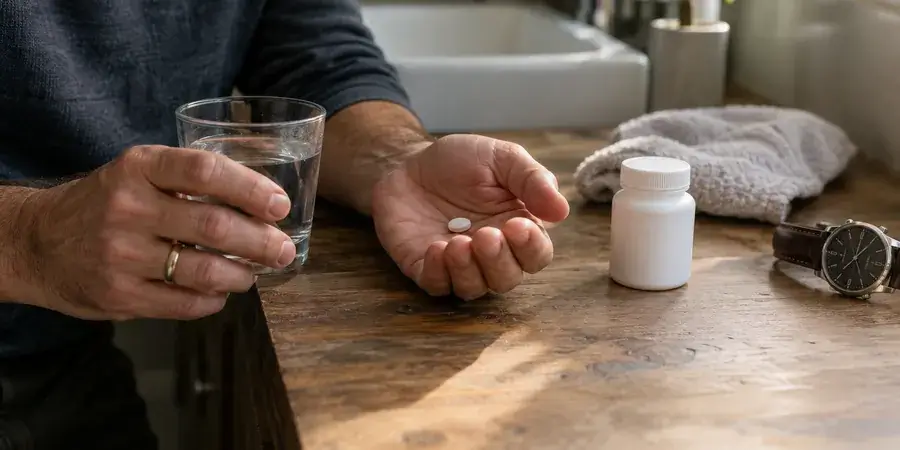
Orforglipron is a small non-peptide molecule that survives digestion and absorbs regardless of meals, so the Foundayo label sets no timing or water rule. For many people, that routine difference is the deciding factor between the two pills.
Why doses go up step by step
Every product starts at a low dose and climbs in steps of about four weeks, as listed in the cost table below. The slow climb gives the gut time to adapt, since nausea and vomiting peak at the start and after each increase. Prescribers can hold a patient at one step for longer when side effects persist. The dose path in any cost estimate is therefore an assumption, and your own path may be slower.
Why tirzepatide has no pill
Tirzepatide is a peptide too, and no oral version is approved. Products sold online as “oral tirzepatide” or dissolving tablets are compounded and lack FDA approval. The approved oral alternatives are the Wegovy pill and Foundayo, a daily tablet people often set against weekly Zepbound.
Trial results range from 12% to 21% average loss, across separate studies
Average weight loss in the pivotal trials ranges from about 12% to 21% of body weight over 64 to 72 weeks. The trials enrolled different people and used different methods. Read the table as an order of magnitude for each drug, since only SURMOUNT-5 compared two of these drugs directly.
| Drug and dose | Trial | Length | Average loss on drug | Placebo |
|---|---|---|---|---|
| Wegovy pen 2.4 mg | STEP 1 | 68 weeks | 14.9% | 2.4% |
| Wegovy pill 25 mg | OASIS 4 | 64 weeks | 13.6% (all participants) / 16.6% (adherent) | 2.2% / 2.7% |
| Zepbound 5 / 10 / 15 mg | SURMOUNT-1 | 72 weeks | 15.0% / 19.5% / 20.9% | 3.1% |
| Foundayo 17.2 mg (36 mg capsule in trial) | ATTAIN-1 | 72 weeks | 12.4% (efficacy estimand) | figure absent from the trial summary used here |
| Zepbound vs Wegovy pen, max tolerated dose | SURMOUNT-5 | 72 weeks | 20.2% vs 13.7% | no placebo arm |
Why the Wegovy pill has two numbers
The 13.6% figure counts everyone randomized, including people who skipped doses or stopped. The 16.6% figure assumes everyone took the drug as directed. Both are correct: the first is closer to what a typical patient sees. The second shows what the drug does with full adherence. Comparing one drug’s adherent figure with another drug’s all-participant figure inflates the gap.
Foundayo trial doses do not match label doses
The ATTAIN trials used capsules dosed from 1 to 36 mg. US pharmacies sell tablets dosed from 0.8 to 17.2 mg, because tablets absorb differently. Lilly’s medical information service states the rule in one line.
Capsules and tablets are not substitutable on an mg-per-mg basis.
Lilly Medical Information, Foundayo dosing answer
Lilly lists these tablet equivalents for the capsule doses used in the trials.
- 6 mg capsule = 5.5 mg tablet (7.8% average loss in ATTAIN-1).
- 12 mg capsule = 9 mg tablet (9.3%).
- 24 mg capsule = 14.5 mg tablet.
- 36 mg capsule = 17.2 mg tablet (12.4%).
The head-to-head and the high-dose pen
SURMOUNT-5 enrolled 751 adults in the US and Puerto Rico. Tirzepatide produced 20.2% average loss against 13.7% for injectable semaglutide, or 22.8 kg against 15.0 kg. Wegovy HD 7.2 mg was approved in March 2026 on the STEP UP trial. At 72 weeks, 89% of its users lost at least 5% of body weight, against 38% on placebo.
GLP-1 cost without insurance: self-pay prices by dose
The GLP-1 cost without insurance now depends on dose and on the manufacturer’s direct program, because few cash buyers pay list price anymore. Lilly and Novo Nordisk both sell directly to patients with a valid prescription. The prices below come from LillyDirect and NovoCare on October 15, 2026, and exclude needles, syringes and the prescriber’s fee.
| Drug | Dose | Price per fill | What one fill covers | Conditions |
|---|---|---|---|---|
| Zepbound (KwikPen or vial) | 2.5 mg | $299 | 28 days | Starting dose only |
| Zepbound | 5 mg | $399 | 28 days | None |
| Zepbound | 7.5 to 15 mg | $449 | 28 days | Refill within 45 days, otherwise $499 (7.5 mg) or $699 (10 to 15 mg) |
| Wegovy pen | 0.25 and 0.5 mg | $199 | 28 days (4 pens) | First two fills for new patients, through Dec 31, 2026 |
| Wegovy pen | 0.25 to 2.4 mg | $349 | 28 days (4 pens) | After intro fills |
| Wegovy HD | 7.2 mg | $399 | 28 days | None listed |
| Wegovy pill | 1.5 / 4 mg | $149 / $199 | 30 tablets | None listed |
| Wegovy pill | 9 and 25 mg | $299 | 30 tablets | None listed |
| Foundayo | 0.8 and 2.5 mg | $149 | 30 tablets | 2.5 mg price reduced through Dec 31, 2026 |
| Foundayo | 5.5 mg | $199 | 30 tablets | Reduced through Dec 31, 2026 |
| Foundayo | 9 / 14.5 / 17.2 mg | $299 | 30 tablets | 14.5 and 17.2 mg require a refill within 45 days |
The 45-day refill rule
Lilly ties its lower high-dose prices to its Journey programs. Miss a Zepbound refill by more than 45 days, and the price for 10, 12.5 or 15 mg jumps from $449 to $699 per fill. A two-week gap after a 28-day fill stays inside the window, while a two-month pause does not, so plan travel and pharmacy timing around that limit.
Self-pay discount against list price
List prices remain far higher than any self-pay figure. An independent price tracker published list prices in September 2026. Against those, the self-pay maintenance prices work out to these discounts.
- Zepbound: $449 vs $1,086.37 list, about 59% off.
- Wegovy pen: $349 vs $1,349.02 list, about 74% off.
- Wegovy pill: $299 vs $1,349.02 list, about 78% off.
- Foundayo: $299 vs $649 list, about 54% off.
Coupon-site pharmacy prices usually fall between these two figures. Check the dose and the number of days covered before comparing.
The real yearly GLP-1 cost: 28-day injection months vs 30-day pill months
Manufacturer pages quote prices “per month,” and the month changes length by product. Pens and vials count a month as 28 days, or four weekly doses, while pill bottles hold 30 tablets. Over a year, injection users buy 13 fills and pill users buy about 12. A $299 injection fill and a $299 pill bottle therefore produce different yearly totals.
Normalized to 30 days, Zepbound’s $449 fill is about $481. The Wegovy pen’s $349 fill becomes about $374, and Wegovy HD’s $399 fill about $428. Pill prices stay as quoted.
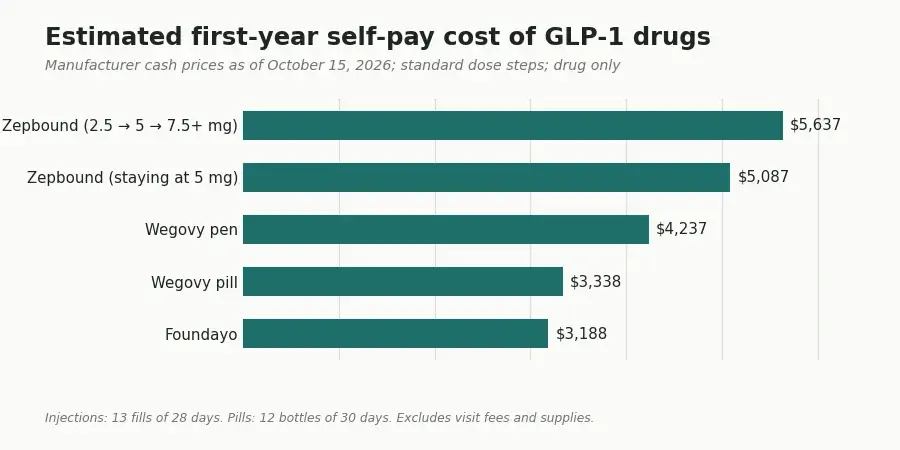
First-year cost with standard dose steps
The calculation assumes manufacturer self-pay, standard monthly dose increases and no missed refills, using the prices in the previous table and excluding visit fees and supplies.
| Drug | Dose path assumed | Fills in year one | Calculation | Year-one total |
|---|---|---|---|---|
| Zepbound | 2.5 mg, 5 mg, then 7.5 mg or higher | 13 x 28 days | $299 + $399 + 11 x $449 | $5,637 |
| Zepbound, staying at 5 mg | 2.5 mg, then 5 mg | 13 x 28 days | $299 + 12 x $399 | $5,087 |
| Wegovy pen | Two intro fills, then up to 2.4 mg | 13 x 28 days | 2 x $199 + 11 x $349 | $4,237 |
| Wegovy pill | 1.5, 4, 9 mg, then 25 mg | 12 x 30 days | $149 + $199 + 10 x $299 | $3,338 |
| Foundayo | 0.8, 2.5, 5.5 mg, then 9 mg or higher | 12 x 30 days | $149 + $149 + $199 + 9 x $299 | $3,188 |
The pill rows cover 360 days and the injection rows 364. For a strict 365-day comparison, add roughly $50 to the pill totals. Foundayo’s total relies on reduced 2.5 mg and 5.5 mg prices that Lilly lists through December 31, 2026. A patient starting in 2027 may pay more for those early steps.
At maintenance, the yearly gap between the most and least expensive option is about $2,200, which is a real sum for most households. Clinical fit, side effects and the daily-pill routine still belong ahead of price in the decision.
Yearly cost estimator
Uses the self-pay prices and dose steps in the table above, checked October 15, 2026.
Injections: 28-day fills. Pills: 30-day bottles. Excludes needles and supplies.
TrumpRx, LillyDirect and NovoCare: one price, three doors
TrumpRx is a federal portal that lists discounted drug prices and sends buyers to the manufacturer’s own cash channel. For GLP-1 drugs, that means LillyDirect for Zepbound and Foundayo and NovoCare for Wegovy, at the prices in the self-pay table above. An independent tracker checked TrumpRx in September 2026 and found Zepbound from $299, the Wegovy pill and Foundayo from $149, and Wegovy pens from $199 for intro fills.
The same portal lists the diabetes brands. The tracker recorded Ozempic pens from $199 for intro fills and Mounjaro at $499. Both are approved for type 2 diabetes, so a prescription written for weight loss alone would be off-label, a choice that stays with the prescriber.
Which door fits which situation
- Cash buyer with a prescription: order through LillyDirect or NovoCare directly, or through TrumpRx, which lands on the same pages.
- Commercially insured with coverage: use a retail or mail-order pharmacy with the manufacturer savings card.
- Medicare Bridge enrollee: use a pharmacy that routes the claim to the Bridge processor, covered in the Medicare section.
Rules that apply to all three
- A valid prescription is required everywhere. None of the three issues prescriptions.
- Cash purchases sit outside insurance, so they do not count toward a plan deductible or out-of-pocket maximum.
- A February 2026 review by the Academy of Managed Care Pharmacy found that listing manufacturer programs on TrumpRx did not appear to change a drug’s net price. It added that insured patients would likely find lower copays elsewhere.
Counterfeit weight-loss drug websites are widely reported, so type the manufacturer’s address yourself instead of following an ad or a social media link. Treat any site offering branded pens far below $199 as suspect.
Insurance: about one in five large employers covers weight-loss GLP-1s
Coverage for weight loss remains the exception in employer plans. In the KFF 2025 Employer Health Benefits Survey, 19% of firms with 200 or more workers said they cover GLP-1 drugs for weight loss. Another 57% said they do not, and 24% were unsure. Among firms with 5,000 or more workers, 43% cover them in their largest plan, up from 28% in 2024.
How to check your plan
- Open the plan’s drug formulary and search each brand name. Plans may list Zepbound but not Wegovy, or the reverse.
- Look for prior authorization and step therapy flags next to the drug.
- Ask the plan or HR whether a weight-management exclusion applies, even when the drug appears on the formulary.
- If covered, activate the manufacturer savings card. It can lower the copay to $25 a month, and for Wegovy the savings cap is $100 a month.
Prior authorization and denials
Prior authorization usually asks the prescriber to document three things.
- Current BMI, measured by a clinician.
- Weight-related conditions, such as high blood pressure or prediabetes.
- Earlier weight-loss attempts, often with dates.
A denial can be appealed, and the self-pay price stays available as a fallback. Savings cards do not work with Medicare, Medicaid or other government coverage.
Medicaid coverage by state
Thirteen state Medicaid programs covered GLP-1s for obesity under fee-for-service as of January 2026, according to KFF, down from 16 in October 2025. California, New Hampshire, Pennsylvania and South Carolina dropped coverage in that period. North Carolina ended coverage in October 2025 and reinstated it in December. Confirm with your state program before filling a prescription.
Medicare GLP-1 Bridge: $50 a month, with strict conditions
The 2003 law that created Part D excluded drugs used for weight loss. Part D plans still cannot cover GLP-1s for weight loss alone. They can cover them for type 2 diabetes, heart risk, sleep apnea or fatty liver disease when the label supports it. The Medicare GLP-1 Bridge is a separate CMS program, running from July 1, 2026, through December 31, 2027, that charges $50 a month regardless of income.
Who qualifies
The June 2026 CMS fact sheet sets three base conditions: Part D coverage, age 18 or older and one of these BMI rules.
- BMI of 35 or higher.
- BMI of 30 or higher with certain heart failure, hard-to-control high blood pressure or chronic kidney disease stage 3a or above.
- BMI of 27 or higher with prediabetes, or a past heart attack, stroke or blocked arteries in the legs or arms.
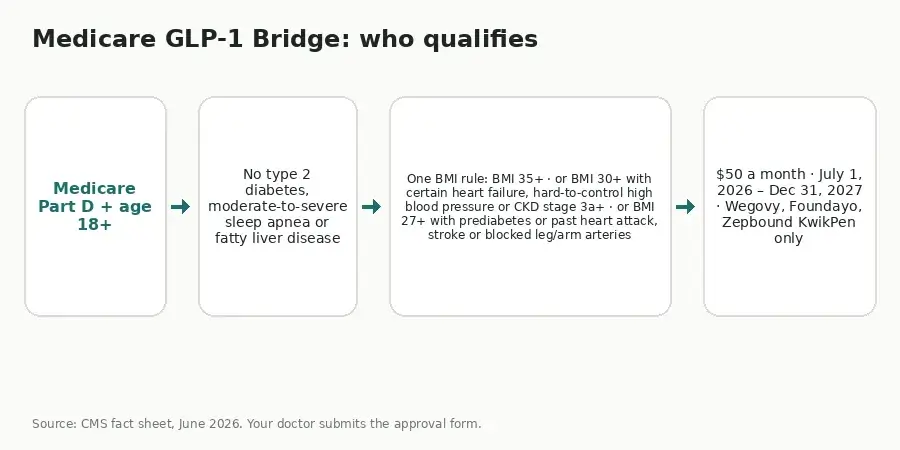
Part D can come from a standalone drug plan or a Medicare Advantage plan with drug coverage. You are excluded if you have type 2 diabetes, moderate-to-severe sleep apnea or fatty liver disease. In those cases your Part D plan may already cover a GLP-1. People already getting a GLP-1 through their plan must stay on that route. Private fee-for-service, cost-contract and PACE enrollees are excluded too.
Covered drugs and the fine print
- Covered: Foundayo, Wegovy injection or tablet, and Zepbound in the KwikPen only. Zepbound vials and single-dose pens are not covered.
- The $50 does not count toward the Part D deductible or yearly out-of-pocket limit.
- These drugs are excluded from the Medicare Prescription Payment Plan.
- Pharmacy trade press reports that no low-income subsidy (Extra Help) applies.
- A KwikPen month is 28 days, so a full year on Zepbound costs $650 in copays. Thirty-day pill fills cost $600.
How enrollment works
- Your doctor sends the prescription to a pharmacy.
- The pharmacy checks eligibility with your Medicare ID.
- Your doctor submits a form to Medicare, and a letter confirms coverage.
- You pay $50 per one-month supply. Refills on the same drug need no new approval, even after a dose change.
Claims run through a central Bridge processor, so a claim billed to your usual Part D plan is rejected. Pharmacy Times reported in July 2026 that a notable share of eligible patients were turned away in the first weeks. Medicare answers questions about the program at 1-800-MEDICARE (1-800-633-4227).
How to get a GLP-1 prescription online, step by step
A GLP-1 prescription online follows the same medical standard as an office visit. GLP-1 drugs are not controlled substances, so federal telemedicine limits on controlled drugs do not apply. The clinician must still hold a license in the state where you are located. A typical telehealth GLP-1 visit runs in this order.
- Intake questionnaire: height, weight, medical history, current medications, past weight-loss attempts and goals.
- Clinician review: a physician or nurse practitioner reviews the answers, usually by video, and may order lab work.
- Decision: the clinician prescribes, asks for more information or declines because of a contraindication.
- Pharmacy routing: the prescription goes to LillyDirect, NovoCare, a retail pharmacy or the service’s partner pharmacy.
- Insurance or self-pay: the service may file a prior authorization or set you up on the manufacturer’s cash price.
- Follow-up: dose increases need check-ins, often monthly at first and about every three months once the dose is stable.
What a visit costs
Visit fees are billed separately from the drug. One national pharmacy chain’s virtual program lists $49 per visit with no subscription in October 2026, with medication billed separately. Subscription services bundle visits into a monthly fee instead. Take one intake, three monthly check-ins and three quarterly ones. At $49 each, that year of visits adds about $343 to the drug cost.
Who gets declined
Clinicians on a GLP-1 telehealth platform most often decline or pause a request for these reasons.
- BMI below the label threshold without a qualifying condition.
- Personal or family history of medullary thyroid carcinoma or MEN 2.
- Pregnancy, plans to conceive soon, or breastfeeding.
- History of pancreatitis or severe gastroparesis, which calls for in-person evaluation.
Checking a telehealth GLP-1 service before you pay
The FDA’s BeSafeRx guidance sets the baseline test for any online pharmacy. It must require a prescription and list a US address and phone number. It must have a licensed pharmacist available and hold a state board of pharmacy license. The FDA advises checking that license in the state board database and walking away if the pharmacy is missing.
Questions to ask the service
- Which clinician reviews my case, and is that person licensed in my state?
- Which pharmacy fills the prescription, and is it a retail, mail-order or compounding pharmacy?
- Is the medication the FDA-approved brand product in manufacturer packaging?
- What is the total monthly cost, split into visit fees and medication?
- Can I cancel without a fee, and what happens to an unfilled prescription?
Red flags
- No questionnaire or clinician contact before payment.
- Prices far below the manufacturer’s self-pay floor for branded pens or pills.
- Promises of a set number of pounds lost by a date.
- Compounded products described as “the same as” Wegovy or Zepbound.
- Pens or tablets with foreign-language labels, damaged seals or past expiry dates.
The FDA lists the same physical warning signs for any medicine bought online. A drug that looks different from your last fill, arrives damaged or carries an unfamiliar label should go back unused. Report it to the pharmacy and, if needed, to the FDA’s MedWatch program.
The clinician check takes two minutes. Every state medical or nursing board runs a free online license lookup, and the name on your prescription should appear there with an active license in your state. A service that will not name the prescriber before you pay fails the first test.
Compounded GLP-1s in 2026: what stays legal and what the FDA changed
Compounded semaglutide and tirzepatide spread during the shortages that began in 2022. Federal rules let pharmacies copy drugs listed in short supply. The FDA declared the tirzepatide shortage over in December 2024 and the semaglutide shortage over on February 21, 2025.
When the grace periods ended
| Drug | 503A pharmacies (state-licensed) | 503B outsourcing facilities |
|---|---|---|
| Tirzepatide | February 18, 2025 | March 19, 2025 |
| Semaglutide | April 22, 2025 | May 22, 2025 |
The semaglutide dates also depended on a court ruling in a compounders’ lawsuit, whichever came later. Compounding itself remains legal. A licensed pharmacy can still prepare a customized version for one patient with a documented clinical need, such as an allergy to an ingredient. What ended is the copying of the commercial product at scale.
The two pharmacy types work under different rules. A 503A pharmacy is licensed by its state and compounds for individual prescriptions. A 503B outsourcing facility registers with the FDA, follows federal manufacturing standards and can produce larger batches. Neither type submits its GLP-1 products for FDA approval, so quality depends on the individual pharmacy and cannot be checked from the label alone.
The 2026 enforcement wave
- In 2025 the FDA sent more than 100 letters to telehealth and compounding companies.
- On February 20, 2026, it warned 30 more telehealth companies whose websites presented compounded GLP-1s as comparable to approved drugs.
- The agency’s position: compounded drugs are not reviewed for safety, effectiveness or quality before sale and cannot be promoted as equivalent.
Brand self-pay prices now start at $149 a month. The brand product comes with an FDA-reviewed label, consistent dosing and a traceable supply chain.
Who should not take GLP-1 medications, and common side effects
All five products carry a boxed warning about thyroid C-cell tumors, based on rodent studies whose relevance to humans has not been established. The labels share these core contraindications.
- Personal or family history of medullary thyroid carcinoma (MTC).
- Multiple Endocrine Neoplasia syndrome type 2 (MEN 2).
- Known serious allergy to the drug or any ingredient.
Warnings to discuss before starting
The Foundayo label lists warnings that appear in similar form across the class.
- Acute pancreatitis and gallbladder disease.
- Kidney injury from dehydration after vomiting or diarrhea.
- Low blood sugar when combined with insulin or sulfonylureas.
- Worsening diabetic eye disease in people with a history of it.
- Aspiration risk during anesthesia or deep sedation, so tell the care team before any procedure.
Pregnancy is a stop signal for the whole class. The Foundayo label says to discontinue when pregnancy is recognized and advises against use while breastfeeding. Oral contraceptives can also lose reliability, so Foundayo users should add a barrier method for 30 days after starting and after each dose increase. Zepbound guidance sets a 4-week window for the same purpose.
How common side effects are
Digestive effects dominate and peak at the start and after each dose increase. The Foundayo label reports these rates at 17.2 mg, compared with placebo.
- Nausea: 35% vs 10%.
- Diarrhea: 25% vs 11%.
- Constipation: 24% vs 9%.
- Vomiting: 24% vs 4%.
Rates differ by drug and trial, and each drug page in this guide covers its own label. Stanford Medicine clinicians report that about half of adults who start a GLP-1 stop within a year, with side effects and cost as the usual reasons.
What GLP-1 weight loss does not fix
The drugs work only while you take them. In the STEP 1 extension, people who stopped semaglutide regained about two-thirds of their lost weight within a year. Loss also slows over time, and Stanford clinicians report a slowdown around months four to six and a plateau between 12 and 18 months. Plan for long-term use and its cost from the first visit.
When the response is small
The same Stanford review notes that 10% to 15% of patients lose close to no weight, even at the maximum dose. Clinicians usually reassess after a few months at a stable dose. Switching molecules, for example from semaglutide to tirzepatide, is a common next step. That decision belongs to the prescriber, since doses do not convert one to one.
Muscle, skin and stubborn fat
- Muscle: part of any fast weight loss is lean mass. Adequate protein and resistance training reduce that share, according to the Stanford review.
- Skin: large losses can leave loose skin on the abdomen, arms and thighs, which no medication tightens. Once weight has been stable for some months, some patients consider tummy tuck surgery or similar body contouring.
- Localized fat: small pockets that resist diet and medication are a contouring question. Laser liposuction procedures reshape such areas and are not a method of losing weight in obesity.
GLP-1 treatment does not replace bariatric surgery for everyone. Surgery produces larger average losses and lasts without ongoing medication, and some patients combine both. Starting weight, medical history and goals decide the route, together with your clinician.
About this guide: review, sources and affiliate disclosure
This guide is written for adults in the US researching GLP-1 treatment and does not replace medical advice. Facts were checked against FDA labeling, LillyDirect and NovoCare price pages, the CMS Medicare GLP-1 Bridge fact sheet, Prices and program terms change every one to three months, so each figure carries its check date.
- Last reviewed: October 15, 2026. Next scheduled review: January 2027, or sooner when manufacturer prices change.
- KFF surveys and published trial reports. Our primary sources were lilly.com/lillydirect/medicines/zepbound, www.novocare.com/ and www.medicare.gov.
- Affiliate disclosure: some buttons on this site lead to telehealth partners that may pay us a commission when you start a visit. Partner payments do not change the prices, eligibility rules or trial data reported here. Links to manufacturer and government programs are not monetized.