
Foundayo side effects are mostly digestive, and most people can expect them to ease over time. In the two large weight trials behind the FDA label, nausea, constipation, diarrhea and vomiting led the list. They were most frequent while the dose was being raised. Most were mild or moderate. A small share of people had serious problems such as pancreatitis, gallbladder disease or kidney injury from dehydration, and the label carries a boxed warning about thyroid tumors. Some symptoms mean you should call a doctor promptly.
This guide is based on the Foundayo (orforglipron) prescribing information revised in July 2026 and on published results from the ATTAIN trials. It shows how often each side effect appeared at each dose, when problems tend to start and fade, and which symptoms need a call to a doctor. It does not offer treatment advice, and your prescriber is the right person to manage any reaction you have.

In this guide
Foundayo side effects at a glance
The label lists every reaction that affected at least 5% of people on Foundayo and occurred more often than on placebo. The figures pool two 72-week trials with more than 4,700 adults, one in people without diabetes and one in people with type 2 diabetes.
| Side effect | Placebo | 5.5 mg | 9 mg | 17.2 mg |
|---|---|---|---|---|
| Nausea | 10% | 26% | 34% | 35% |
| Constipation | 9% | 20% | 27% | 24% |
| Diarrhea | 11% | 21% | 23% | 25% |
| Vomiting | 4% | 13% | 21% | 24% |
| Indigestion (dyspepsia) | 4% | 12% | 16% | 13% |
| Abdominal pain | 7% | 13% | 14% | 14% |
| Headache | 7% | 8% | 9% | 9% |
| Bloating (abdominal distension) | 3% | 7% | 9% | 8% |
| Fatigue | 4% | 6% | 7% | 9% |
| Burping (eructation) | 1% | 6% | 8% | 8% |
| Acid reflux (GERD) | 2% | 6% | 6% | 7% |
| Gas (flatulence) | 2% | 5% | 6% | 6% |
| Hair loss | 2% | 4% | 4% | 5% |
Two patterns stand out. Every reaction on the list involves the gut except headache, fatigue and hair loss. The jump from placebo to 5.5 mg is also larger than the jump between the higher doses. Most of the extra risk arrives early on the dose ladder.
The label does not give separate figures for the 0.8, 2.5 and 14.5 mg tablets. The first two are short starting steps, and 14.5 mg was not one of the maintenance doses in the large trials.
Extra cases per 100 people, compared with placebo
Percentages alone can mislead, because many people on placebo also reported gut symptoms. Subtracting the placebo rate shows how many extra people out of 100 had each problem because of the drug. We calculated these figures from the label table above.
| Side effect | 5.5 mg | 9 mg | 17.2 mg |
|---|---|---|---|
| Nausea | 16 | 24 | 25 |
| Vomiting | 9 | 17 | 20 |
| Constipation | 11 | 18 | 15 |
| Diarrhea | 10 | 12 | 14 |
| Any digestive reaction | 23 | 31 | 32 |
| Stopped because of side effects | 3 | 6 | 7 |
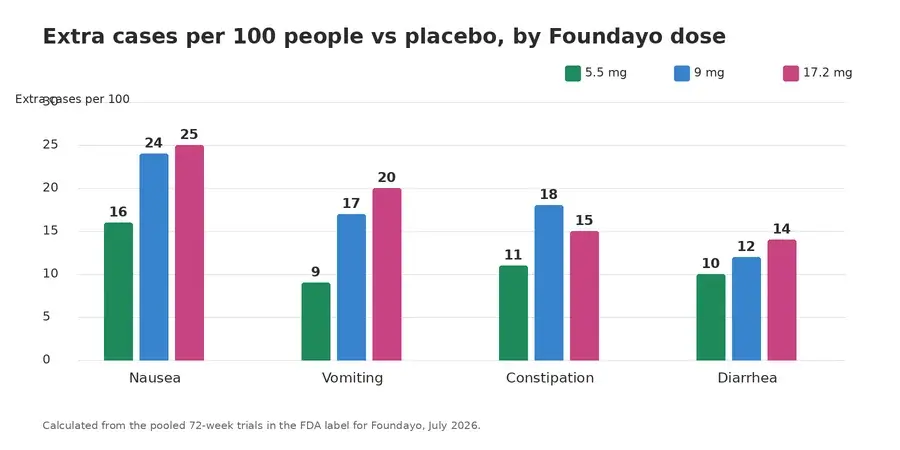
Read this way, about one extra person in four has nausea on 9 mg or 17.2 mg. The step from 9 mg to 17.2 mg adds very little extra nausea or digestive trouble, while vomiting keeps rising. Constipation is the one complaint that is lower at 17.2 mg than at 9 mg.
These are averages across thousands of people and two trials. They cannot predict how one person will react, and some people have almost no symptoms at any dose.
Stomach and gut side effects by dose
Digestive reactions as a group affected 60% of people on 5.5 mg, 68% on 9 mg and 69% on 17.2 mg. On placebo the figure was 37%, which shows how common these complaints are even without the drug. Among people on Foundayo who had a digestive reaction, the label reports 60% mild, 36% moderate and 4% severe cases.
Side effects included the usual gastrointestinal problems of nausea, constipation, diarrhea, vomiting and dyspepsia.
Ken Fujioka, MD, director of the Nutrition and Metabolic Research Center, Scripps Clinic, in Healio’s Endocrine Today, October 2025
Fujioka was commenting on the ATTAIN-1 results presented at a European diabetes meeting in September 2025. His point was that orforglipron behaves like the rest of the GLP-1 class, even though it is a small-molecule pill.
Compare Foundayo side effects by dose
Pick one of the three doses tested in the trials to see how often each side effect appeared in the pooled 72-week trials, next to placebo. Figures come from the FDA label, July 2026. They are trial averages and cannot predict how you will react.
Nausea and vomiting
Nausea is the single most common of the orforglipron side effects, reported by about one in three people on 9 mg or 17.2 mg. Vomiting followed the same dose pattern and was six times more common on 17.2 mg than on placebo. The drug slows the rate at which the stomach empties, which adds to the feeling of fullness and can tip into nausea after a large or fatty meal.
Constipation and diarrhea
Constipation peaked at 9 mg, where 27% reported it, against 9% on placebo. Diarrhea rose more evenly with dose, from 21% on 5.5 mg to 25% on 17.2 mg. Some people have both at different points in treatment. Ongoing diarrhea matters more than it seems, because fluid loss is the main route to the kidney problems described later in this guide.
Indigestion, burping, bloating and reflux
These milder upper-gut complaints are easy to overlook in trial summaries. Combined, they are common: indigestion affected up to 16% of people, bloating up to 9%, burping up to 8% and acid reflux up to 7%. Each was rare on placebo, with burping at only 1%. Report reflux that is new or worse, since your prescriber may want to rule out other causes.
When Foundayo side effects start and how long they last
The label states that nausea, vomiting and diarrhea were more frequent during dose escalation and decreased over time. That matches the way the drug is started. Foundayo begins at 0.8 mg and rises one level at a time, with at least 30 days on each step. The body gets used to each strength before the next one.
The tolerability and safety profile of orforglipron was consistent with the GLP-1 receptor class.
Sean Wharton, MD, PharmD, medical director of the Wharton Medical Clinic and assistant professor at the University of Toronto, in Healio’s Endocrine Today, October 2025
Speaking about the ATTAIN-1 results, Wharton described most digestive events as happening during dose escalation. In practice, the days after each step up are the period to watch most closely.
| Period | Earliest timing on the label | What to expect |
|---|---|---|
| Starting dose, 0.8 mg | Days 1 to 30 | Lowest strength, mainly a period to adjust |
| Step to 2.5 mg | From day 31 | First noticeable rise in fullness for some people |
| Step to 5.5 mg | From day 61 | Digestive reactions become clearly more common than on placebo |
| Steps to 9, 14.5 and 17.2 mg | From day 91, one level at a time | Nausea and vomiting peak around the higher doses |
| Stable dose | Weeks to months after the last step | Nausea, vomiting and diarrhea usually ease |
The pace of the ladder is flexible. The label sets 30 days as the minimum on each step, so a prescriber can hold you longer at a dose that is hard to tolerate. Our guide to Foundayo doses explains each step and the restart rule after missed tablets.
Why a break can bring symptoms back
Tolerance to the gut effects fades during a pause. The label says that after 7 or more missed days in a row, the dose ladder should restart at a lower level to reduce digestive reactions. Going straight back to a high dose after a week off is a common way to trigger strong nausea again.
How many people stop Foundayo because of side effects
Most people kept taking the drug despite side effects, though the share who stopped rose with dose. The label pools both trials, while the ATTAIN-1 results reported by Healio cover only adults without diabetes.
| Measure | Placebo | 5.5 mg | 9 mg | 17.2 mg |
|---|---|---|---|---|
| Any side effect, pooled trials (FDA label) | 3% | 6% | 9% | 10% |
| Digestive side effect, pooled trials (FDA label) | 0.7% | 3% | 6% | 6% |
| Any side effect, ATTAIN-1 (Healio, October 2025) | 2.7% | 5.3% | 7.9% | 10.3% |
At the top dose, roughly one person in ten stopped because of side effects, against fewer than three in a hundred on placebo in ATTAIN-1. Severe digestive reactions affected about 3% of people on Foundayo and 1% on placebo, according to the label’s warning section.
Dropout figures from trials often understate real-world stopping, because trial participants receive close follow-up. Cost, supply and side effects all play a part outside a study. Our breakdown of Foundayo cost covers the price side of staying on treatment.
Foundayo and hair loss
Hair loss appears in the label at 4% on 5.5 mg and 9 mg and 5% on 17.2 mg, against 2% on placebo. The label links it to weight reduction itself, a pattern also seen after rapid weight loss from other causes.
- Women on Foundayo: 7% reported hair loss, against 3% of women on placebo.
- Men on Foundayo: 0.9%, against 0.7% of men on placebo.
- All doses combined: a small rise over placebo, with the clearest gap in women.
The hair thinning that follows fast weight loss is usually diffuse shedding rather than bald patches. Tell your prescriber if shedding is heavy, patchy or lasts for months, since thyroid problems, iron deficiency and other conditions can cause similar changes.
Timing and what may help
Shedding linked to weight loss often shows up two to four months after the trigger, so it can appear well after the first dose. It usually settles once weight becomes stable, and regrowth then takes several months. The label does not report how long hair loss lasted in the trials.
- Ask whether your protein intake is enough, since appetite can fall sharply on the drug.
- Ask about blood tests for iron, thyroid function or vitamin levels if shedding is heavy.
- Mention any recent illness, surgery or stress, which can cause the same pattern.
- Avoid starting hair supplements without advice, as some interfere with lab tests.
Headache, fatigue, heart rate and blood pressure
A few non-digestive effects also appear in the label. Most are small differences from placebo, yet they matter for people with heart conditions or on blood pressure drugs.
| Effect | Foundayo | Placebo | Note |
|---|---|---|---|
| Headache | 8% to 9% | 7% | Small difference from placebo |
| Fatigue | 6% to 9% | 4% | Highest on 17.2 mg |
| Fast heart rate (tachycardia) | 3% | 0.9% | Average rise of 4 to 5 beats per minute |
| Low blood pressure (hypotension) | 2% | 0.5% | 4% in people on blood pressure drugs |
The average heart rate rose by 4 to 5 beats per minute on Foundayo, compared with 0.5 on placebo. Low blood pressure was more common in people who also took medicine for hypertension, at 4% against 1% in those who did not. As weight falls, blood pressure often drops too, so a prescriber may review those medicines during treatment.
Feeling lightheaded when standing, fainting or a racing heart that does not settle should be reported. Fatigue can also reflect eating much less than before, which is worth raising at a follow-up visit.
Serious side effects in the Foundayo label
The label’s warnings section covers nine risks. Some are rare in the trials, and the figures below put each one in proportion.
| Risk | Foundayo | Placebo | What the label says |
|---|---|---|---|
| Thyroid C-cell tumors | Boxed warning | Not applicable | Do not use with a history of medullary thyroid cancer or MEN 2 |
| Acute pancreatitis | 6 confirmed cases, 0.14 per 100 patient-years | 2 events in 1 person, 0.04 per 100 patient-years | Stop the drug if pancreatitis is suspected |
| Severe digestive reactions | About 3% | About 1% | Not recommended with severe gastroparesis |
| Gallstones | 1% | 0.7% | Test if gallbladder disease is suspected |
| Acute gallbladder inflammation | 0.4% | 0.3% | Same as above |
| Acute kidney injury | 0.2% | 0.05% | Most cases followed dehydration from gut symptoms |
| Allergic reactions | 0.5% | 0.3% | Stop the drug and seek care for anaphylaxis or swelling |
The thyroid boxed warning
The boxed warning comes from animal studies of GLP-1 drugs, where thyroid C-cell tumors appeared in rodents. Whether this happens in people is not known. Foundayo must not be used by anyone with a personal or family history of medullary thyroid cancer or multiple endocrine neoplasia type 2.
Pancreatitis and raised enzyme levels
Six people on Foundayo had confirmed pancreatitis in the trials. The label also reports that average amylase rose by 16% to 20% and lipase by 26% to 31%, against 3% and 4% on placebo. The meaning of these enzyme rises is unclear when there are no other signs of pancreatitis, so routine blood tests may show them without any problem.
Kidney injury, eyes and anesthesia
Acute kidney injury, sometimes needing dialysis, has been reported with GLP-1 drugs, including Foundayo. Most cases happened after vomiting or diarrhea caused dehydration, which is why the label advises checking kidney function in people with those symptoms.
For people with type 2 diabetes, fast improvement in blood sugar has been linked to temporary worsening of diabetic eye disease. Foundayo was not studied in people with eye disease needing urgent treatment, so they need monitoring. The label also warns that food may stay in the stomach during anesthesia or deep sedation, so the surgical team should know you take it.
Low blood sugar on Foundayo: who is at risk
On its own, Foundayo rarely causes low blood sugar. The risk rises sharply when it is combined with insulin or a sulfonylurea, the diabetes drugs that push insulin levels up whatever the glucose level.
- Adults without diabetes (Trial 1): glucose below 54 mg/dL in 0.6% on Foundayo and none on placebo, with no severe episodes.
- Adults with type 2 diabetes (Trial 2): low blood sugar in 2% on Foundayo against 0.2% on placebo, including one severe case.
- People on a sulfonylurea in Trial 2: 7% had low blood sugar, compared with 0.5% of those not on one.
The label says the dose of insulin or a sulfonylurea may need to be lowered when Foundayo starts. That decision belongs to the prescriber who manages your diabetes.
The Medication Guide lists these warning signs of low blood sugar: dizziness or lightheadedness, sweating, confusion or drowsiness, headache, blurred vision and slurred speech. It also names shakiness, a fast heartbeat, anxiety or mood changes, hunger, weakness and feeling jittery.
Other points for people with type 2 diabetes
The second weight trial enrolled 1,613 adults with type 2 diabetes and a BMI of 27 or more. At the start, 11% of them already had diabetic eye disease, which is why the label’s eye warning applies mainly to this group. Weight loss was smaller than in people without diabetes, while the pattern of gut side effects was pooled with the first trial in the label.
People with diabetes may be checking glucose at home already. A run of lower readings after a dose step is worth reporting even without symptoms, because the dose of other diabetes drugs may need to change. Anyone with eye disease should keep regular eye exams during treatment.
When to call a doctor about Foundayo side effects
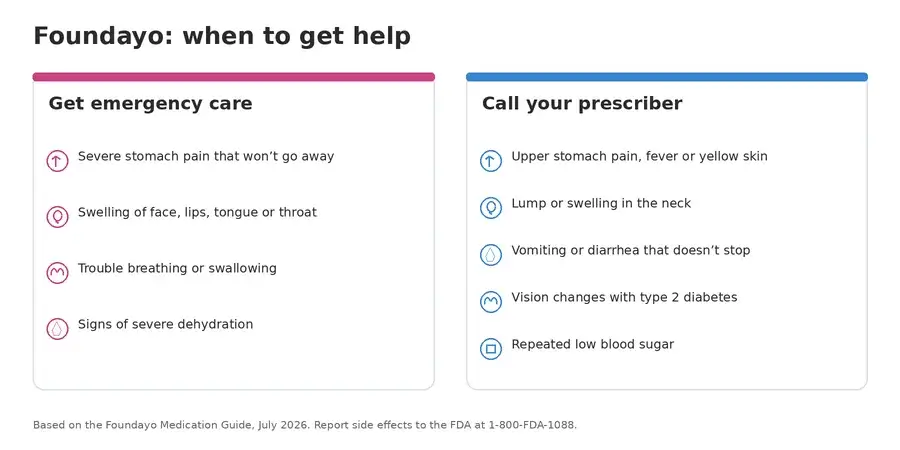
Most digestive symptoms ease with time, yet some need prompt attention. Most symptoms below come from the Medication Guide, grouped here by how quickly to act.
Get emergency care right away
- Severe pain in the stomach area that will not go away, with or without vomiting, sometimes spreading to the back.
- Swelling of the face, lips, tongue or throat, trouble breathing or swallowing, fainting or a very fast heartbeat.
- Signs of severe dehydration, such as very little urine, confusion or dizziness after ongoing vomiting or diarrhea.
- Two or more tablets taken by mistake with severe symptoms; for advice, call Poison Help at 1-800-222-1222.
Call your prescriber soon
- Upper stomach pain, fever, yellow skin or eyes, or clay-colored stools, which can point to gallbladder trouble.
- A lump or swelling in the neck, hoarseness, trouble swallowing or shortness of breath.
- Nausea, vomiting or diarrhea that does not stop, or stomach problems that are severe.
- Any change in vision if you have type 2 diabetes.
- Repeated low blood sugar readings or symptoms.
- Heavy or patchy hair loss, or fatigue that limits daily life.
Before any planned surgery, procedure with sedation or dental work under anesthesia, tell the care team you take Foundayo. You can also report side effects to the FDA through MedWatch at 1-800-FDA-1088.
Questions to ask your prescriber before you start
- Which symptoms should make me call you, and which can wait for the next visit?
- Can I stay longer on a dose if nausea or vomiting does not settle?
- Do any of my current medicines need a dose change, including blood pressure or diabetes drugs?
- What should I do about birth control during the dose steps?
- When should my kidney function or blood sugar be checked?
- What should I tell a surgeon or dentist before a procedure?

Medicines that can raise Foundayo side effects
Some medicines change how much orforglipron reaches the blood or add to its effects. The label sets specific limits for them, and higher drug levels generally mean a higher chance of side effects.
| Medicine | Effect | What the label advises |
|---|---|---|
| Strong CYP3A4 inhibitors, such as some antifungals and antibiotics | Raise orforglipron levels, which may increase side effects | Foundayo capped at 9 mg daily |
| Ritonavir and similar drugs that block both CYP3A4 and OATP1B | Raise levels further | Avoid combining them |
| Insulin or a sulfonylurea | Higher risk of low blood sugar | Consider lowering the diabetes drug dose |
| Blood pressure medicines | Low blood pressure in 4%, against 1% without them | Report dizziness or fainting |
| Simvastatin | About twice the statin exposure | Do not exceed 20 mg a day |
| Birth control pills | May work less well | Extra protection for 30 days at the start and after every dose step |
Foundayo also slows stomach emptying, which may change how other oral medicines are absorbed. Bring a full list of prescriptions, over-the-counter products and supplements to your first visit. A pharmacist can check each one against the label, including short courses such as an antibiotic for a week.
Taking Foundayo with another GLP-1 drug, such as a semaglutide or tirzepatide injection, is not recommended. Combining them would add similar side effects without a tested benefit.
Foundayo vs Wegovy pill side effects
GLP-1 pills side effects look alike across the class, and both daily pills cause the same kind of digestive complaints, though their trials were run separately with different placebo groups. The table compares each drug’s top dose with its own placebo arm.
| Measure | Foundayo 17.2 mg | Its placebo | Wegovy pill 25 mg (OASIS 4) | Its placebo |
|---|---|---|---|---|
| Nausea | 35% | 10% | 46.6% | 18.6% |
| Vomiting | 24% | 4% | 30.9% | 5.9% |
| Any digestive side effect | 69% | 37% | 74% | 42.2% |
| Stopped because of side effects | 10% | 3% | 6.9% | 5.9% |
The raw rates of nausea and vomiting were higher in the Wegovy pill trial. Its placebo group also reported more of both, so the gap above placebo is closer than it looks. The Wegovy pill had fewer people stopping for side effects, and its gap over placebo for stopping was smaller.
No head-to-head weight-loss trial of the two pills has been published. In April 2026, an indirect analysis funded by Novo Nordisk estimated higher odds of stopping for side effects on Foundayo. Its authors urged caution because event numbers were small. ACHIEVE-3, a direct trial in type 2 diabetes, compared orforglipron with older, lower-dose oral semaglutide tablets.
The routines differ too. The Wegovy pill must be taken on an empty stomach with a 30-minute wait, while Foundayo has no food rule. Our full Foundayo vs Wegovy pill review covers weight results and daily use, and the Zepbound comparison sets the pill against a weekly shot.
What patients report in Foundayo reviews
Trial tables show averages, while patient reviews show what living with the drug feels like. As of October 2026, one large US drug-information website listed 62 user reviews of Foundayo, with an average score of 7.1 out of 10. About 53% of reviewers described a positive experience and 13% a negative one.
- Side effects mentioned most often: nausea, constipation, diarrhea, fatigue, headaches and upset stomach.
- Also mentioned: heartburn, tiredness in the afternoon and anxiety.
- Positive themes: less appetite and food noise, feeling full sooner and weight loss, often after dose increases.
- Negative themes: stalled weight loss, ongoing constipation or gut symptoms, low mood and one report of a serious reaction needing emergency care.
Forums such as Reddit carry similar accounts, which we do not quote here. Reviews are self-selected and unverified, so they cannot tell you how common a problem is. They are useful mainly as a reminder that side effects differ widely from person to person.
Several reviewers said they had switched from a weekly injection such as Wegovy, Zepbound or Mounjaro. Their accounts vary, and no published trial has measured side effects after a switch from an injection to Foundayo. Anyone switching should agree on a starting dose with the prescriber rather than guessing from the old one.
Is Foundayo safe? What is still unknown
The FDA approved Foundayo in April 2026 after reviewing trials in thousands of adults. Its safety profile in those studies looked like that of other GLP-1 drugs, with gut symptoms as the main burden and serious events uncommon. Some questions remain open.
- Trial length: the weight trials lasted 72 weeks, so effects over many years are not yet known.
- Real-world use: the drug has been on the US market only since spring 2026, and rare problems may surface as more people take it.
- Pregnancy: the label says to stop the drug once pregnancy is recognized.
- Birth control pills: Foundayo may make them less reliable, and the label advises extra protection for 30 days at the start and again after every dose step.
- Liver disease: the drug is not recommended in severe liver impairment.
- Kidney disease: the label sets no dose change for kidney impairment, yet dehydration from gut symptoms can still harm the kidneys.
- Age: Foundayo is approved for adults only, and it has not been studied for weight loss in children or teens.
Mood and mental health
The Foundayo label does not list depression or suicidal thoughts among its warnings. Some patient reviews do mention low mood or anxiety, and a large drop in food intake can affect energy and mood. Report any new or worsening mood changes to your prescriber, and call or text 988 at any time if you have thoughts of harming yourself.
People with a history of pancreatitis, gallbladder disease, kidney problems or severe gastroparesis should discuss those conditions before starting. To see how this pill compares with the other options, read our GLP-1 weight loss guide.
About this guide: Foundayo safety sources and disclosure
This guide is for US adults and gives general information only. Your prescriber and pharmacist know your health history and should guide any decision about side effects. Rates and warnings come from the Foundayo prescribing information and Medication Guide revised in July 2026. ATTAIN-1 dropout figures and both doctor quotes come from Healio’s October 2025 report, and review data were checked on a public drug-review site in November 2026. Our primary sources were uspl.lilly.com, www.drugs.com and www.healio.com.
Affiliate disclosure: some buttons on this site lead to telehealth partners that may pay us a commission when you start a visit. These partners prescribe FDA-approved brand drugs only, and payments do not change the facts reported here.