
A GLP-1 prescription online starts with a health questionnaire and a review by a clinician licensed in your state. If the drug suits you, the prescription goes to a pharmacy that ships or holds it for pickup. The whole route usually takes 3 to 10 days on self-pay, and several weeks when insurance needs a prior authorization. Visit fees run from nothing at the manufacturer pharmacies to about $149 a month at full-service memberships, as of October 2026, on top of the drug price.
This guide walks through each step of a telehealth GLP-1 visit. It covers what the clinician will ask for, who gets turned away and what the visit really costs. It also shows how to check the clinic and the pharmacy before paying. Whether a GLP-1 drug is right for you is a medical decision, made with the prescriber who reviews your history.

In this guide
Can telehealth prescribe a GLP-1?
Can telehealth prescribe GLP-1 drugs? Yes, a licensed clinician can prescribe one after a telehealth visit, and the prescription is as valid as one written in an office. GLP-1 drugs are not controlled substances. The federal rules that limit online prescribing of controlled drugs therefore do not apply to Wegovy, Zepbound, Foundayo or the Wegovy pill.
Two conditions still apply to every online visit. The clinician needs an active license for the state you are physically in at the time of the visit. And the visit has to meet the same standard of care as an in-person appointment, which means a real review of your history and medicines.
Why phentermine is different
Phentermine, an older weight-loss pill, is a Schedule IV controlled substance. Online prescribing of controlled drugs falls under separate federal telemedicine rules, and many services do not offer it for that reason. People comparing weight-loss options online sometimes see both drugs on one menu, though the legal route for each is different.
The online visit, step by step
Most telehealth GLP-1 programs follow the same six stages, so learning how to get GLP-1 online comes down to knowing what each stage asks of you. The order below reflects how the major services described their process in October 2026.
Before a clinician sees your case
- Choose a route. You can start from a manufacturer pharmacy that lists telehealth partners, from a pharmacy chain’s virtual clinic, from a membership service or from a telehealth program run through your employer or health plan.
- Fill in the intake form. Expect questions on height, weight, past weight changes, medical conditions, family history, current medicines, allergies, pregnancy plans and earlier GLP-1 use. Most forms take 10 to 15 minutes.
- Verify your identity. Many services ask for a government ID, and some ask for a photo or a recent weight reading.
Review, prescription and delivery
- Clinician review. A physician, nurse practitioner or physician assistant reads your answers. Depending on the service and the state, this happens by message, by phone or by video, and some cases need lab results first.
- Decision and prescription. The outcome is a prescription, a request for more details or a decline. An approved prescription goes electronically to a pharmacy.
- Pharmacy fill and delivery. The pharmacy checks insurance or applies the cash price, then ships the drug or holds it for pickup.
Starting from a manufacturer pharmacy
LillyDirect lists independent telehealth providers that can prescribe Lilly drugs, with visit rates the providers report themselves. Lilly says it does not endorse those providers, that fees may vary and that the listed rates exclude medication. The prescription then goes to LillyDirect Pharmacy, which applies savings offers and handles checkout. Novo Nordisk sells the Wegovy pill through NovoCare and lists telehealth partners such as Ro, LifeMD and WeightWatchers.
Each stage can stall. Missing answers, an unclear medical history or a blood pressure reading the clinician wants to recheck all add days. A complete, honest intake form is the single biggest time saver.
Message-based or video visits
Some services review a written intake and reply by secure message, a format called asynchronous care. Others require a live video call before a first prescription. Some states and some services require video or recent labs for a first GLP-1 prescription. If you prefer a conversation with the prescriber, choose a service that offers video at the start.
How long it takes, from intake to first dose
The timeline depends mainly on whether insurance is involved. Self-pay routes are fast, because the pharmacy only needs the prescription and payment.
| Stage | Self-pay route | Insurance route |
|---|---|---|
| Intake form | 10 to 15 minutes | 10 to 15 minutes, plus insurance details |
| Clinician review | Same day to 48 hours | Same day to 48 hours |
| Lab work, if requested | 1 to 5 days | 1 to 5 days |
| Prior authorization | Not needed | Several days to several weeks |
| Pharmacy fill and shipping | 2 to 7 days | 2 to 7 days after approval |
| Total to first dose | About 3 to 10 days | About 2 to 6 weeks |
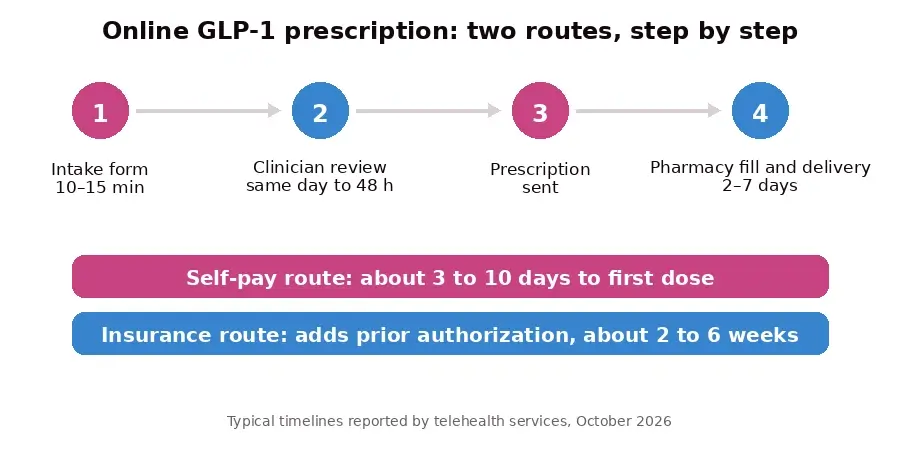
A same-day prescription is realistic through telehealth, and a same-day first dose is not. The drug still has to be filled and delivered, and refrigerated injections ship with cold packs. Pickup at a retail pharmacy can shorten the last step when the pharmacy has the dose in stock.
What to have ready before the intake form
Preparing a few facts in advance shortens the review and lowers the chance of a request for more information. The list below covers what clinicians most often ask for.
- A current weight from a reliable scale and your height, for the BMI calculation.
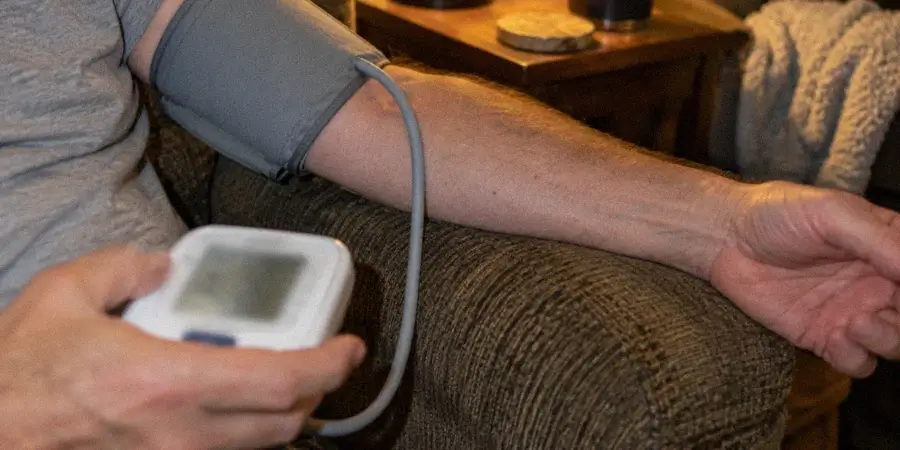
- A recent blood pressure reading, if you have one from a pharmacy machine or home monitor.
- A full list of prescription drugs, over-the-counter medicines and supplements, with doses.
- Diagnoses such as high blood pressure, prediabetes, sleep apnea or high cholesterol, which can qualify you at a lower BMI.
- Family history of thyroid cancer, especially medullary thyroid carcinoma or MEN 2.
- Records of any earlier GLP-1 use: drug, last dose and last fill date.
- Your insurance card, if you want the service to try coverage first.
Why earlier GLP-1 records matter
A person moving from one service to another often wants to keep the current dose. Without proof of the last dose and fill date, a careful clinician may restart at the lowest step to limit side effects. A pharmacy label, a screenshot of the old prescription or a visit summary is usually enough to avoid that restart.
Labs and measurements a clinician may ask for
Many programs prescribe from history alone for a healthy adult. Others order blood work first, especially for people with diabetes, kidney disease or many medicines. Recent results from your own doctor, usually from the past 12 months, often count.
| Test | Why it is asked for |
|---|---|
| Hemoglobin A1C or fasting glucose | Screens for diabetes or prediabetes, which changes drug choice and coverage |
| Metabolic panel with kidney function | Vomiting and diarrhea can strain the kidneys, so a baseline helps |
| Liver tests | Gives a baseline before treatment starts |
| Lipid panel | Documents heart risk, which can support coverage |
| Thyroid tests | Checks thyroid function before treatment when history suggests it |
| Pregnancy test | GLP-1 drugs should not be used in pregnancy |
A service that never asks about labs is not automatically unsafe. A service that skips every question about medical history is a different matter. Gretel Schueller, managing editor of Health at U.S. News and World Report, said in August 2026 that “these are still prescription medicines,” and a full history review is part of that.
Who may be declined or sent to in-person care
A refusal is part of a legitimate service, and it usually points to a safety reason or a missing criterion. Common reasons include a BMI below the label threshold, a thyroid cancer history and pregnancy plans. Several other situations also lead to a pause or a referral.
- Age outside the service’s range. Most programs treat adults only, and some set an upper age limit as well, such as 70 at one service.
- A location the service does not cover. Clinicians must be licensed where you are, so some services operate in only part of the country.
- Medicines that need adjustment, such as insulin or sulfonylureas, which can push blood sugar too low when combined with a GLP-1.
- A current or past eating disorder, which many clinicians want to assess in person before prescribing a drug that cuts appetite.
- Recent or planned surgery, since GLP-1 drugs slow stomach emptying and anesthesia teams need to plan for it.
- Symptoms that need an exam, such as unexplained weight change or severe abdominal pain.
A decline is not a final answer about treatment. It often means the next step should be your own primary care doctor or an obesity medicine specialist, who can examine you and order tests in person.
What a telehealth GLP-1 visit costs in October 2026
The drug and the visit are billed separately at most services. Manufacturer pharmacies charge for the drug only, while membership services add a monthly fee for clinician access and support.
| Program type | Example | Drug | Added fee | Monthly total |
|---|---|---|---|---|
| Manufacturer pharmacy | NovoCare | $299 | None, prescriber billed separately | $299 |
| Retail clinic, per visit | CVS MinuteClinic | $299 | $29 a visit | $328 |
| Discount platform membership | GoodRx for Weight Loss | $299 | $39 a month | $338 |
| Pharmacy chain, per visit | Walgreens | $299 | $49 a visit | $348 |
| Weight program membership | WeightWatchers Clinic | $299 | $74 a month on a 12-month plan | $373 |
| Telehealth membership | Sesame | $299 | $99 a month | $398 |
| Full-service membership | Ro, Hims & Hers, LifeMD | $299 | $149 a month | $448 |
Over a year, the fee gap is larger than the monthly figures suggest. At $149 a month, a membership adds $1,788 to the drug cost. A per-visit model with an intake and quarterly check-ins at $29 might add about $145 a year, though monthly visits during dose increases raise that figure.
A year of visit fees, compared
The yearly fee depends on how a service bills. The figures below use the fees listed above, assuming 12 monthly charges for memberships. For per-visit models, the range runs from 5 visits, an intake and four quarterly check-ins, to 12 monthly visits.
- Manufacturer pharmacy with your own doctor: no telehealth fee, only your usual office or insurance charges.
- CVS MinuteClinic at $29 a visit: about $145 to $348 a year.
- Walgreens at $49 a visit: about $245 to $588 a year.
- GoodRx for Weight Loss at $39 a month: $468 a year.
- WeightWatchers Clinic at $74 a month: $888 a year.
- Sesame at $99 a month: $1,188 a year.
- Ro, Hims & Hers or LifeMD at $149 a month: $1,788 a year.
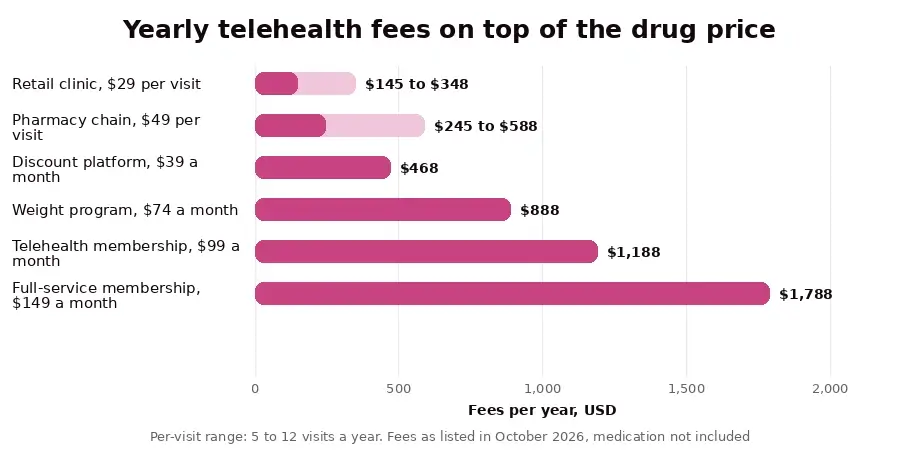
Higher fees usually buy more contact, such as unlimited messaging, coaching or insurance support. Whether that is worth $1,000 or more a year depends on how much help you expect to need during dose increases.
Yearly cost calculator: drug plus telehealth fees
Estimate a first year at one price level. Prices as listed in October 2026; your dose steps and plan terms can change the total.
Lab tests, supplies and insurance savings are not included.
Questions that reveal the full price
- Is the medication included in the monthly price, or billed by the pharmacy on top?
- Which dose does a quoted price cover, and what happens to the price at the next step?
- Are lab tests, follow-up visits and messaging included or charged one by one?
- Is there a minimum term, and what does early cancellation cost?
Drug prices themselves depend on the product. Self-pay prices for Lilly’s weekly injection, with the refill rules that change them, are set out in our breakdown of Zepbound cost without insurance.
Insurance route or self-pay route
Choosing a route before the visit saves time. The two paths differ in speed, paperwork and who does the work.
Employer and health plan programs
Some employers and insurers include a GLP-1 telehealth program as a benefit. Eligibility comes through the plan, and the program’s clinicians handle prior authorization and appeals. Teladoc, for example, notes that filling a prescription can take several weeks under this route. Coverage still depends on your plan’s rules, deductibles and any program requirements to stay enrolled.
Using insurance
- Check the plan formulary for each brand name first, since plans often list one GLP-1 and exclude another.
- Ask whether the telehealth service submits prior authorizations, and whether it charges for that work.
- Expect a prior authorization to take several days to several weeks, with a possible denial and appeal.
- With a covered drug, manufacturer savings cards can bring a covered fill down to $25 a month for people with commercial insurance.
Paying cash
- Manufacturer self-pay prices ran from $149 a month for starting pill doses to $449 per 28 days for top Zepbound doses, as of October 2026.
- No prior authorization is needed, so the drug can ship within days of the prescription.
- Government plan members can still pay cash, though they cannot use manufacturer savings cards.
Medicare enrollees
The Medicare GLP-1 Bridge covers Wegovy, the Wegovy pill, Foundayo and the Zepbound KwikPen at $50 a month through December 2027. It is open to Part D enrollees who meet its health criteria. The prescriber must submit a prior authorization, so the telehealth service needs to support that step. Ask before the visit whether the clinician will file Bridge requests.
How to check the clinic and the prescriber
A legitimate service tells you who will review your case. The checks below apply to all GLP-1 telehealth providers, take a few minutes and can be done before you pay anything.
- Ask for the prescriber’s full name and credential, such as MD, DO, NP or PA.
- Look up the license in the medical or nursing board of your state. The Federation of State Medical Boards runs a free physician search, and Nursys covers nurse practitioners in most states.
- Confirm the license is active, issued in your state and free of public disciplinary actions.
- Check whether the service is certified by LegitScript, a private company that reviews telemedicine and pharmacy businesses. Major ad platforms such as Google, Meta and TikTok limit health advertising without that certification.
- Search the company name together with the words FDA warning letter, and read any letter you find.
LegitScript offers a public lookup of certified sites. Certification shows that a business passed a compliance review, and it does not rate medical quality or results. A missing certification is a reason to ask more questions.
What the FDA has flagged
The FDA began a wave of enforcement against misleading drug marketing in September 2025. On March 3, 2026, it sent 30 warning letters to telehealth companies over claims about compounded semaglutide and tirzepatide. The letters targeted marketing that implied compounded drugs were the same as approved products, and branding that hid who actually compounded the drug.
We are paying close attention to misleading claims being made by telehealth and pharma companies.
Marty Makary, MD, FDA Commissioner, March 2026
How to check the pharmacy that fills it
The pharmacy matters as much as the clinician, because it is the source of the drug you inject or swallow. A prescription sent to a reputable pharmacy is the strongest protection against counterfeit products.
- Ask for the pharmacy’s name before the prescription is sent, and confirm its license with your state board of pharmacy.
- Know the pharmacy type: retail, mail-order, a manufacturer pharmacy such as LillyDirect or NovoCare, or a compounding pharmacy.
- Use the National Association of Boards of Pharmacy’s safe site search to check any online pharmacy you have not used before.
- On delivery, check for sealed manufacturer packaging, an English label, your name, the correct dose and a valid expiry date.
- For Lilly products, Lilly offers an online tool that checks whether a package is authentic.
If a delivery does not look right
Do not inject or swallow a product you are unsure about. Keep the package, photograph the label and seal, and call the pharmacy that filled it. A suspected counterfeit or a product that made you ill can also be reported to the FDA’s MedWatch safety program, which accepts reports from patients as well as clinicians. Ask the prescriber to send a replacement prescription to a pharmacy you can verify.
NABP has warned that illegal sellers mimic real pharmacies’ websites and packaging. Some take payment and never ship, and others sell GLP-1s labeled as “research” peptides. A real pharmacy always requires a prescription.
Brand-name or compounded: what changes for you
Brand-name GLP-1 drugs are FDA-approved products made by Novo Nordisk or Eli Lilly and shipped in sealed packaging. Compounded versions are mixed by a pharmacy from raw ingredients, and the FDA does not review them for safety, effectiveness or quality before sale.
| Question | Brand-name drug | Compounded product |
|---|---|---|
| FDA review before sale | Yes, full approval | No |
| Clinical trial data | Yes, for the approved form and dose | None for the specific product |
| Packaging | Sealed pen, vial or bottle from the maker | Pharmacy-labeled vial, syringe or tablets |
| Insurance and savings cards | Possible | Almost never |
| Medicare GLP-1 Bridge | Covered for listed drugs | Not covered |
| Cash price | From $149 a month for pills | Often similar or higher once fees are added |
Since the shortages of semaglutide and tirzepatide ended, pharmacies may compound these drugs only in narrow cases. The gap in cash price has also shrunk now that brand pills start at $149. Oral and dissolving products marketed as tirzepatide are a separate concern, and our guide to tirzepatide pills explains why no approved version exists.
Red flags before you pay
Most problems show up before checkout. Any one of the signs below is a reason to stop and ask questions, and several together are a reason to leave.
- Approval promised within minutes, or before anyone has read your history.
- A price for a brand-name pen far below the manufacturer’s self-pay ladder.
- A guaranteed number of pounds or a guaranteed result by a date.
- No named prescriber, no named pharmacy or no way to reach either.
- Payment requested by wire transfer, cryptocurrency or gift card.
- Products sold without a prescription, or labeled for research or not for human use.
- Pressure to prepay six or twelve months before the first visit.
A low price on its own is not proof of fraud, since manufacturer pills now start at $149. The warning sign is a price below what the maker itself charges, which no legitimate pharmacy can match for the same product.
After the prescription: follow-ups, refills and switching
The first prescription is the start of a treatment plan. GLP-1 drugs rise in dose steps, and each step needs a new prescription and a check on side effects.
- Follow-ups are often monthly during dose increases and every few months once the dose is stable.
- Refill timing affects price at some manufacturer programs. Lilly’s lower Zepbound prices at 7.5 mg and above require a refill within 45 days.
- Report severe stomach pain, persistent vomiting or signs of dehydration to the prescriber quickly, outside the routine check-in.
- Tell your own primary care doctor about the prescription, so your full medical record stays complete.
Switching services without losing your dose
You can move to another telehealth service or to your own doctor at any time. Bring your last dose, last fill date and any side effects to the new prescriber. A gap of more than a week or two at some doses may mean restarting lower, so plan the move before the current supply runs out.
Approved drugs, prices and coverage are compared side by side in our GLP-1 weight loss guide.
About this guide: sources and disclosure
This guide is written for adults in the US and does not replace medical advice. Facts were checked against FDA statements on compounded GLP-1 drugs and its March 2026 warning letters, LegitScript’s telemedicine certification page and NABP guidance on illegal online sellers. We also used LillyDirect’s telehealth pages and a tracker of telehealth program prices. Our primary sources were www.legitscript.com, nabp.pharmacy and www.fda.gov. Prices and program terms change every one to three months, so each figure carries its check month.
Affiliate disclosure: some buttons on this site lead to telehealth partners that may pay us a commission when you start a visit. These partners prescribe FDA-approved brand drugs only, and payments do not change the facts reported here.